What is a Sheltie? The Shetland Sheepdog in brief
The Shetland Sheepdog comes from the Shetland Islands, the windswept group north of mainland Scotland. The breed standard used in Canada traces it to the Border Collie of Scotland, taken to the islands and crossed with small longhaired breeds, with Collie crosses added later on. The dog that came out of that mix was small, quick and still very much a worker.
Britain's Kennel Club recognized the breed in 1909, at first under the name Shetland Collie. Collie breeders objected, and the name was changed. In Canada the Canadian Kennel Club recognized the Shetland Sheepdog in 1930 and places it in Group VII, Herding. The current CKC standard took effect in January 2015.
Almost nobody uses the full name at home.
Owners, rescues and club newsletters say Sheltie, and the national club's own web address, canadianshelties.ca, does the same. Search for either name and you land on the same breed, the same standard and the same set of health questions.
Sheltie temperament: loyal, responsive and a little reserved
The CKC standard describes the temperament in a single plain sentence: intensely loyal, affectionate and responsive to the owner, possibly reserved with strangers, but not fearful. Each part of it shows up in daily life. Loyalty means a dog that likes to be in the same room as its people. Responsiveness means a dog that watches you and reacts to small changes in voice and posture, which is a pleasure in a training class and a reason to keep your own signals consistent.
Reserve is the part that surprises first-time owners. A well-bred puppy may hang back from a visitor for a minute before coming over, and that is within the standard. Fear is not. A puppy that trembles, hides or snaps when approached calmly is showing something the breed is not meant to have, and it is worth walking away from that litter.
Meet the mother if you can, and the father if he lives on site. Calm, curious adults tell you far more about the dog you will be living with in three years than a sleepy eight-week-old does. How much reserve shows in an adult varies from dog to dog, so ask the breeder how each parent greets new people at the door.
Size, coat and colours of the Shetland Sheepdog
The CKC standard sets the height at 33–40.75 cm (13–16 in) at the shoulder. A dog outside that range is disqualified in the show ring, though the standard excuses a dog at three shows before the disqualification applies. Pet owners rarely measure, but the range is a useful check when a seller describes a puppy as "toy" or "miniature": there is no such variety in the standard.
The coat is double. A long, straight, harsh outer coat lies over a short, dense, furry undercoat, and together they make a dog that looks far bigger than it is. That undercoat is what keeps the breed comfortable on a January walk and what fills the vacuum during a heavy shed. Brushing takes real time every week, and the grooming and care page sets out a routine.
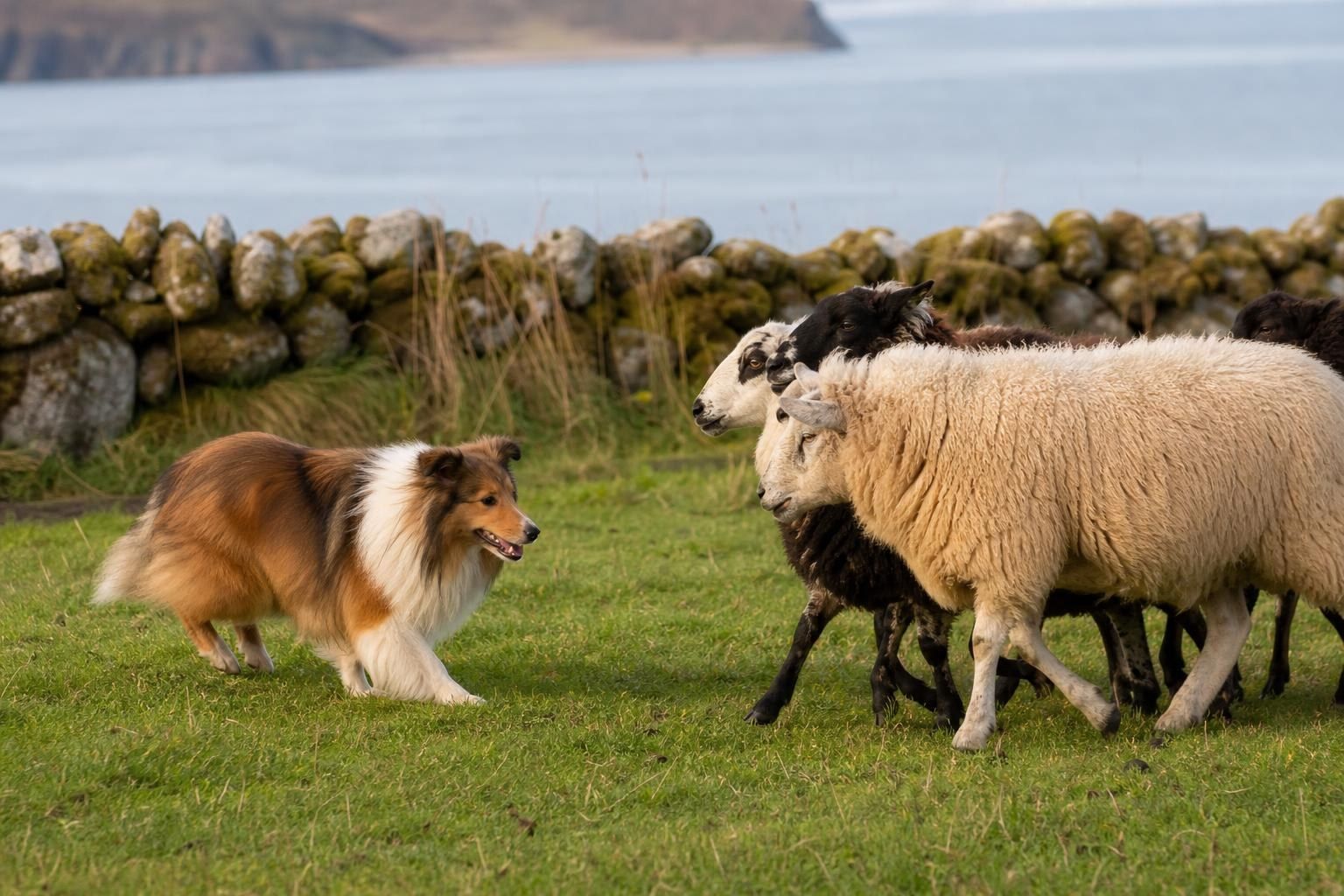
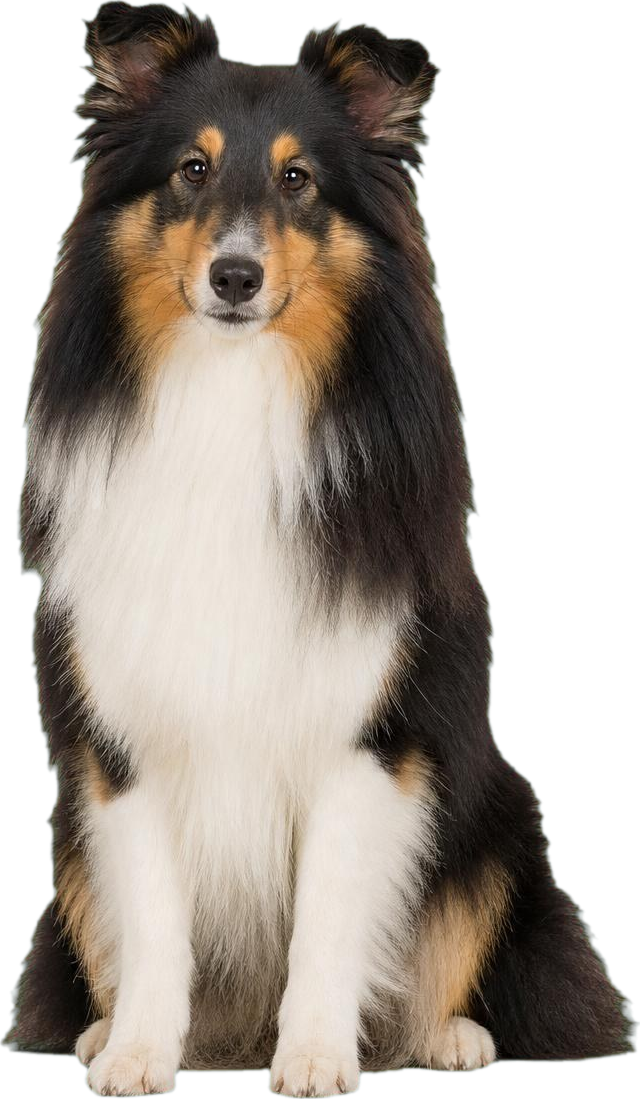
Accepted colours are black, blue merle and sable, the last running from golden to mahogany, each with varying amounts of white and/or tan. In everyday speech that gives sable, tricolour (black, tan and white), bi-black (black and white), blue merle and bi-blue. Brindle is a disqualification. The tricolour in the header and the sable working sheep further down this page are both standard colours.
| Point | Detail | Where it comes from |
|---|---|---|
| CKC group | Group VII, Herding | CKC breed standard |
| Recognized | 1909 in Britain, 1930 in Canada | Breed histories, CKC |
| Height | 33–40.75 cm (13–16 in) | CKC breed standard |
| Colours | Black, blue merle or sable, with white and/or tan | CKC breed standard |
| Lifespan | 12–14 years; 13.4 (median, 2024 UK study) | Breed listings, UK study |
| Puppy price | Roughly $2,000–$4,000 | One Canadian price guide |
The average lifespan of a Sheltie, and the health checks that matter
The average lifespan of a Sheltie is usually given as 12 to 14 years in breed listings from the AKC and Royal Canin. A 2024 UK study of more than half a million dogs put the Sheltie's median lifespan at 13.4 years, against 12.7 years for purebred dogs as a whole. That is a long run for a dog of this size, and it means a puppy brought home this winter could still be on the sofa in the late 2030s.
A long life is not the same as a trouble-free one. The most practical issue is the MDR1 gene mutation, which makes affected dogs dangerously sensitive to certain drugs. Washington State University puts its frequency at about 15 per cent in Shetland Sheepdogs, against roughly 70 per cent in Collies, and testing is the only way to know a particular dog's status. Once you have the result, tell every vet and emergency clinic that treats your dog.
The Shetland Sheepdog health panel at UC Davis also covers collie eye anomaly and von Willebrand disease type III, the most severe form of that inherited bleeding disorder. A separate UC Davis test estimates risk for dermatomyositis, an inherited skin and muscle disease seen in Shelties and Collies. The health guide explains each condition and what a breeder's paperwork should show.
Finding a Sheltie in Canada: clubs, breeders and rescue
The national parent club is the Canadian Shetland Sheepdog Association (CSSA), which works with the CKC. Its site publishes a Code of Ethics for members, a page for new puppy owners and advice on adopting an older dog. The CKC's own Puppy List lets you search member breeders by breed and province, and the CKC suggests contacting the national breed club for referrals as well.
The CSSA's member clubs sit mostly in the West: the Shetland Sheepdog Club of BC, the West Coast Island Shetland Sheepdog Association, also in British Columbia, the Alberta Shetland Sheepdog and Collie Association, and area associations around Saskatoon and Winnipeg. Most of them keep Facebook pages rather than full websites. The Edmonton Shetland Sheepdog Fanciers Club, founded in 1968, is a separate CKC member club with its own site.
No member club is listed for Ontario, Quebec or the Maritimes, so buyers there rely on the Puppy List and the national club. Ontario does have a dedicated rescue: the Southern Ontario Sheltie Rescue Society, a registered charity in Burlington, established in 2003 (according to its Halton community directory listing), which places dogs through foster homes and also takes Rough and Smooth Collies.
With clubs thin on the ground east of Manitoba, a search for a Sheltie in Canada can mean a long drive to meet a litter. Sources suggest roughly $2,000–$4,000 for a puppy from a reputable breeder and around $500–$600 to adopt from a shelter, both from a single Canadian price guide. The guide to finding a puppy lists the questions to ask before any deposit changes hands.
Grooming, exercise and Canadian winters
Plan on brushing a couple of times a week, and more often during a heavy shed. Mats form behind the ears, at the elbows and under the tail, and a light mist of water before brushing helps. Shaving is a poor shortcut: the coat insulates in cold weather and shields the skin from sun, and the Ontario SPCA advises against shaving dogs down in winter.
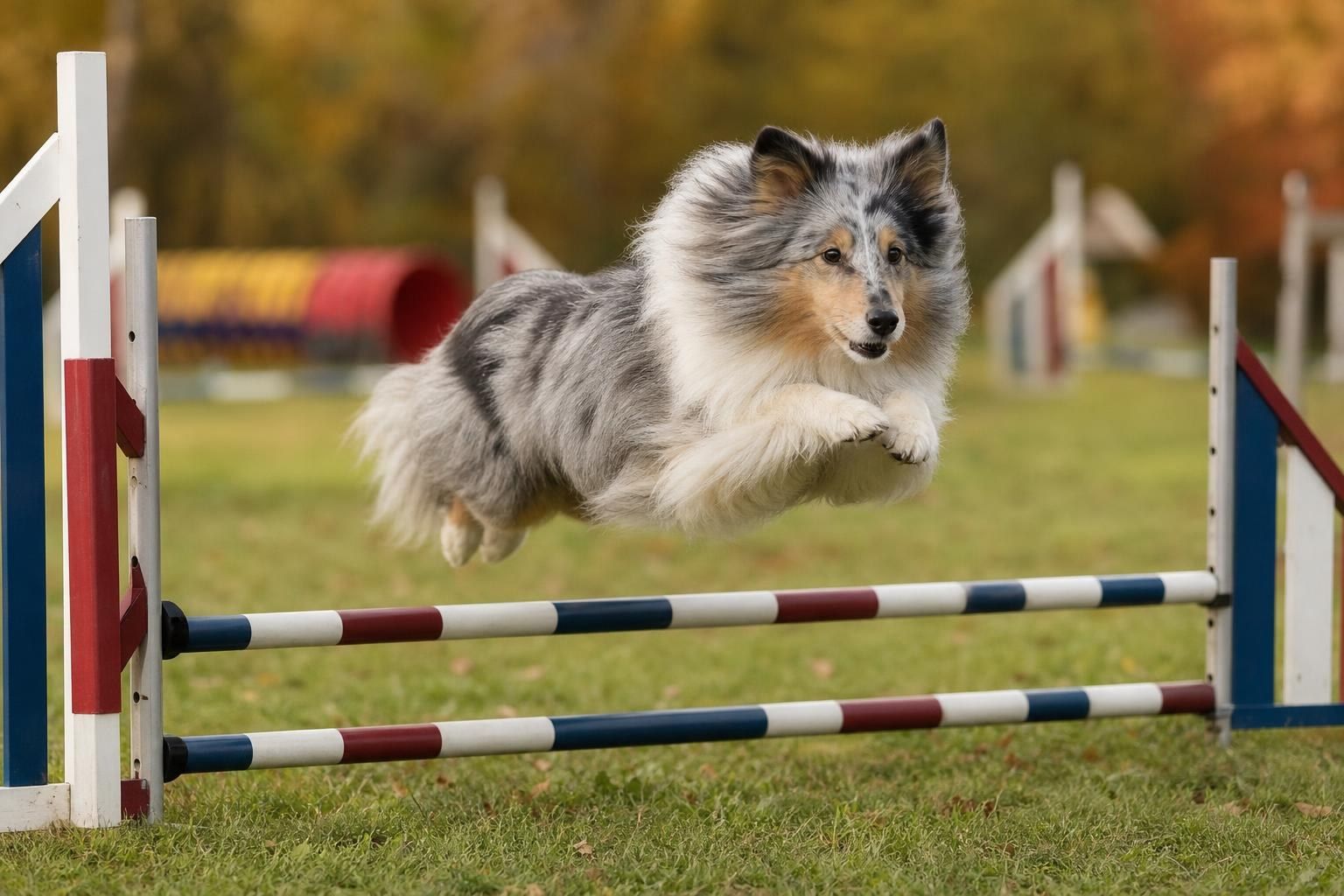
Exercise is about more than distance. A breed developed to work stock alongside a shepherd usually does best with something to think about as well as a walk round the block. The CKC runs performance events such as agility, obedience and rally, and a local training club is the easiest way in. The blue merle above is mid-jump on an agility course.
The double coat copes with a Calgary or Montréal January, where the 1971–2000 normals put the mean at −8.9 °C and −10.4 °C, but feet still need attention. The BC SPCA warns that the salt and ice melt used on sidewalks can hurt a dog's paws, so wash and dry the feet after every winter walk. Antifreeze is the other hazard: the BC SPCA calls it extremely poisonous to pets.
Who the Sheltie suits, and who should look elsewhere
The breed suits owners who want a close, responsive companion and who enjoy teaching a dog things. It fits a family with school-age children who will bring the dog into walks and games, a retired couple with time for regular brushing and training, and anyone curious about dog sports. Its temperament also suits people who like a pet that saves most of its affection for the household rather than every passer-by.
It is a weaker match for anyone who hates dog hair on dark clothes, cannot set aside grooming time every week, or wants a dog that greets every stranger like an old friend. If that last point matters most, the Cavalier King Charles Spaniel is the more openly sociable breed, and the Cavalier or Sheltie comparison puts the two side by side, point by point.
Size is the last thing to settle. Britain's standard aims for dogs of about 37 cm, while Canadian rings accept dogs up to 40.75 cm, and the American and English types page explains where that gap came from.
Where the facts come from
- Canadian Kennel Club: Shetland Sheepdog breed standard
- Canadian Shetland Sheepdog Association: breed standard
- Canadian Shetland Sheepdog Association: member clubs
- Washington State University: MDR1 in dogs
- UC Davis Veterinary Genetics Laboratory: Shetland Sheepdog health panel
- CKC Puppy List
- Southern Ontario Sheltie Rescue Society
- BC SPCA: cold weather care guide
- Scientific Reports: Longevity of companion dog breeds (McMillan et al., 2024)
- Statistics Canada: average daily temperatures by month, 1971–2000 (Environment Canada normals)