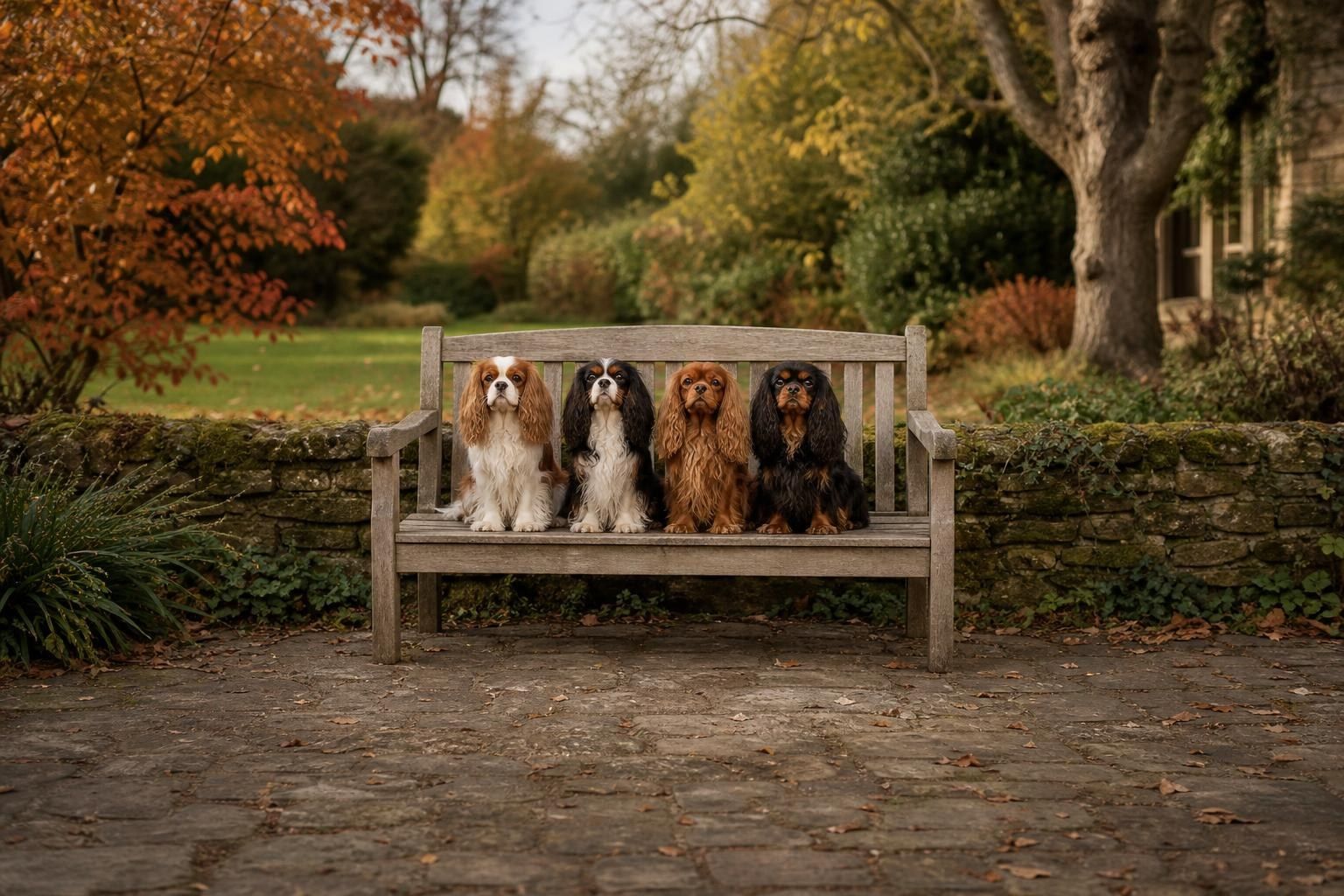
The four colours in the standard
The Canadian Kennel Club standard and the UK Royal Kennel Club standard list the same four colours and stop there. The CKC makes any other colour a disqualification, and the UK standard calls any other colour or combination unacceptable. That short list is one of the easiest things about the breed to learn, and one of the most useful.
Each colour also has a name in the older, closely related breed. In Canada that dog is registered as the English Toy Spaniel, and the CKC uses four variety names for it: King Charles for black and tan, Prince Charles for tricolour, plus Blenheim and ruby. The Cavalier keeps the plain descriptive names.
The table sets out the four side by side, with the wording the KC standard uses.
| Colour | Type | Standard's description | English Toy Spaniel name |
|---|---|---|---|
| Blenheim | Particolour | Rich chestnut on pearly white | Blenheim |
| Tricolour | Particolour | Black and white, tan markings | Prince Charles |
| Ruby | Wholecolour | Whole-coloured rich red | Ruby |
| Black and tan | Wholecolour | Raven black, tan markings | King Charles |
Blenheim and the lozenge spot
Blenheim is the colour most people picture: rich chestnut patches on a pearly white ground. It is also the colour Roswell Eldridge had in mind in 1926, when he offered prizes at Crufts for "Blenheim spaniels of the old type" and set the modern breed in motion.
The standard asks for the head markings to be well and evenly divided, with room between the ears for the lozenge, a small chestnut spot in the white blaze on top of the head. The KC calls it "much valued" and a unique characteristic of the breed.
It is worth keeping the lozenge in proportion. It is a cosmetic detail that breeders and judges like to see, nothing more. A Blenheim without one is just as healthy, just as affectionate and, in a pet home, just as good. If a seller charges extra because a puppy has the spot, you are paying for a patch of chestnut hair.
The standard's word for the chestnut is "rich", and a strong, clear colour against clean white is what breeders aim for.
Tricolour: black, white and tan
A tricolour Cavalier is black and white with tan markings. The black patches sit where a Blenheim's chestnut would, and the tan appears as smaller markings set against the black and white. Done well, it is a striking colour, crisp and clearly defined.
Tricolours tend to look a little more serious in photographs than Blenheims, simply because black reads darker on screen. In person the expression is the same soft one.
Like Blenheims, tricolours are particolours, so the same comments about evenly divided head markings apply. The lozenge, though, is described in the standard as part of the Blenheim pattern.
Practical note for owners: white feathering on a tricolour shows road grime quickly in a Canadian spring thaw. That is a grooming question, covered on the grooming page, not a reason to choose another colour.
Ruby: the whole-coloured red
Ruby is described in the standard as whole-coloured rich red. There is no white ground, so the dog reads as one colour from nose to tail, with the long feathering on ears and legs catching the light.
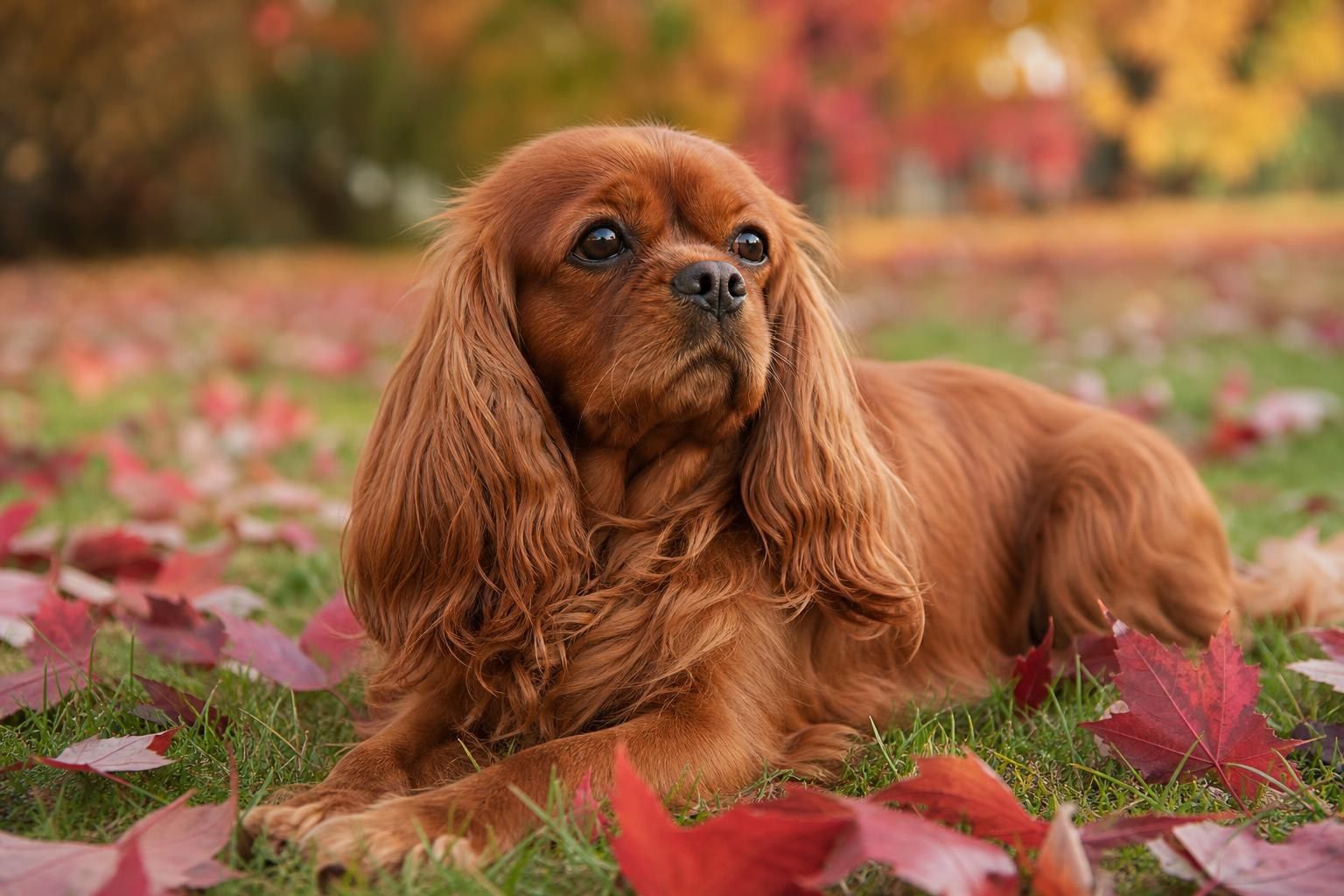
Rubies stand out at a show or a park simply because Blenheims and tricolours are so common. That visibility leads some sellers to call them rare and price them up. They are less common than Blenheims, but they are a standard colour of the breed, and a fair breeder prices a litter on the parents, the health testing and the care that went in, not on a coat.
The standard's own words are the best guide to a good ruby: whole-coloured and rich. A deep, even red is what breeders aim for.
Black and tan
The fourth colour is raven black with tan markings. Like ruby, it is a wholecolour, so there is no white ground. The tan forms smaller markings against the black, a pattern familiar from many other breeds.
Black and tan Cavaliers can look quite different from the Blenheim on most greeting cards, and visitors sometimes assume they are a different breed. In the older English Toy Spaniel, this same colour is the variety called King Charles, which adds to the confusion. The page on the Cavalier and King Charles Spaniel sorts out the names.
The quickest way to tell a black and tan Cavalier from a black and tan English Toy Spaniel is the head. The Cavalier has a flat skull and a longer muzzle; the older breed has a domed skull and a short, flat face.
Particolours, wholecolours and mismarks
Breeders split the four colours into two groups. Particolours have a white ground with coloured patches: Blenheim and tricolour. Wholecolours are solid: ruby and black and tan. The terms come up constantly in conversations with breeders, so they are worth knowing.
A mismark is a dog whose markings do not match what the standard describes, for example uneven head markings on a Blenheim or white where a wholecolour should be solid. In the show ring that is a fault. In a pet home it makes no difference at all, and a well-bred mismarked puppy can be one of the best buys in a litter.
The more serious question is a colour outside the four. Because the standard is so clear, a "Cavalier" offered in some other colour should make you ask whether the puppy is purebred. Some of these dogs are crosses sold under the breed name, which is a separate topic covered on the Cavalier mixes page.
Rare is a sales word
There are four standard colours. A puppy advertised in a rare or unusual colour is either one of those four or a dog the CKC standard disqualifies.
Does colour affect health or price?
No source in this guide's research links coat colour in Cavaliers to heart disease, syringomyelia or any of the breed's other main health problems. Colour is not a health indicator. A Blenheim and a ruby from the same well-screened parents carry the same odds; a Blenheim and a ruby from untested parents carry the same risks.
That is why the useful question is never "which colour is healthiest" but "what testing did the parents have". The health testing guide lists the heart, eye and DNA checks to ask about.
Price is set by breeders, and most reputable ones price a litter the same whatever the colour. Canadian guides put Cavalier puppies from reputable breeders at roughly $2,000–$4,000, with show-bred dogs higher. A large premium for colour alone is a signal to look more closely at the seller. The cost page breaks down the first year.
Choosing a colour, or letting it choose you
Most first-time buyers start with a colour in mind, usually Blenheim. That is fine, but a strong colour preference shrinks the pool of good litters, and waiting longer for the right colour from an untested source is the wrong trade.
A better order runs like this: find a breeder through the CKC Puppy List or the directory of the Cavalier King Charles Spaniel Club of Canada, check the parents' clearances, meet the dogs, and then ask what colours are expected. The breeder guide has the questions.
Rescue and rehoming dogs come in all four colours, too. The adoption page explains how few dogs come up each year and why most are older.
Plenty of owners who held out for a Blenheim end up with a tricolour or a ruby and would not swap. Ask any of them at a park, and the conversation turns to the dog's habits within a minute, not its coat.
Next stopGroomingWhere the facts come from
- Canadian Kennel Club: Cavalier King Charles Spaniel breed standard (PDF)
- Royal Kennel Club: Cavalier King Charles Spaniel breed standard
- Canadian Kennel Club: English Toy Spaniel breed standard (PDF)
- American Kennel Club: Cavalier King Charles Spaniel history
- Canadian Kennel Club: Puppy List
- Cavalier King Charles Spaniel Club of Canada: breeder directory
- Le Bernard: Cavalier King Charles Spaniel price in Canada