One breed, two ideas of size
The Shetland Sheepdog is a single breed with a single origin. It came from the Shetland Islands, and the breed standard used in Canada traces it to the Border Collie of Scotland crossed with small longhaired breeds, with later Collie crosses. Britain's Kennel Club recognized it in 1909, first as the Shetland Collie, and the Canadian Kennel Club followed in 1930.
What split the breed into "types" was not ancestry but geography. Dogs bred in Britain and dogs bred in North America have long been judged against different written standards, and the biggest single difference between those standards is height.
So when a breeder says "American type" or "English type", the most reliable meaning is a dog bred towards the AKC or CKC size range, or one bred towards the smaller British ideal. Anything beyond that is a matter of opinion and, as later sections explain, needs care. The Sheltie overview covers the breed as a whole.
What the UK Kennel Club standard asks for
The Royal Kennel Club standard does not give a range. It gives ideals: 37 cm (14½ in) for dogs and 35.5 cm (14 in) for bitches. A dog more than 2.5 cm above or below that ideal is described as highly undesirable.
Do the arithmetic and the British target for a male runs from about 34.5 cm to 39.5 cm, and for a female from about 33 cm to 38 cm, with the middle of each band preferred. That is a narrower and lower window than the North American one. It is also a softer rule: "highly undesirable" is a serious fault in the ring, but it is not an automatic disqualification.
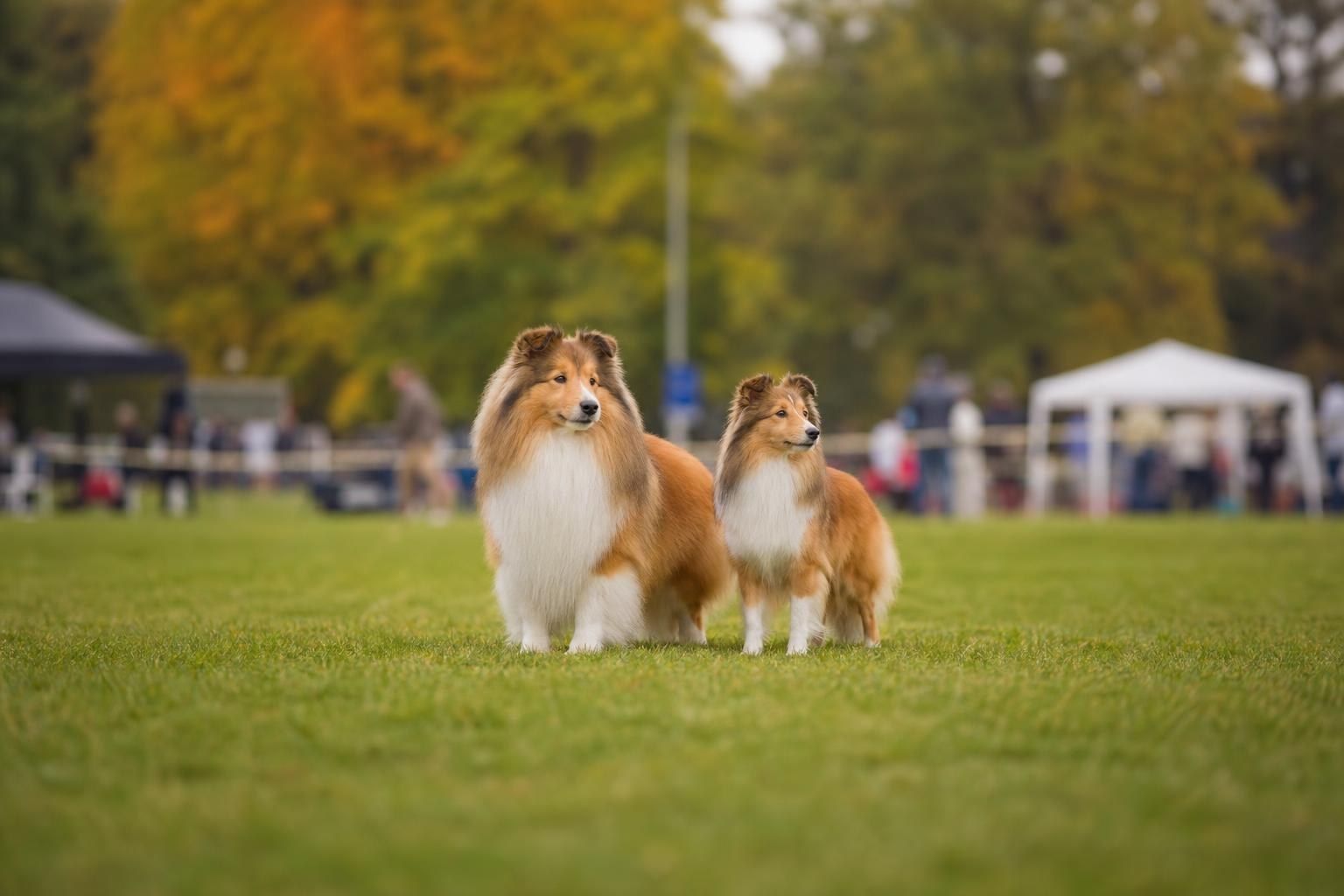
A Sheltie bred to the British standard will usually look finer and lighter beside a North American dog of the same age, which is the difference most people notice first when the two stand together at a show, as in the photo at the top of this page.
The AKC and CKC height range
The AKC standard sets a range of 13 to 16 inches at the withers. A dog outside it is disqualified. There is no single ideal height, so any dog inside the range is acceptable on height alone.
The CKC standard uses the same idea in metric: 33–40.75 cm (13–16 in) at the shoulder. Being over or under that height is a disqualification, though a dog is excused at three shows before it applies. Brindle colour and cryptorchidism in a dog over 12 months are disqualifications too.
Two things follow. First, Canada and the United States treat height as a hard boundary rather than a target. Second, the top of the North American range, 40.75 cm, sits above the upper limit a British judge would accept for even a male dog without heavy penalty.
| Standard | Dogs | Bitches | Outside the figure |
|---|---|---|---|
| UK (Royal Kennel Club) | Ideal 37 cm (14½ in) | Ideal 35.5 cm (14 in) | More than 2.5 cm off: highly undesirable |
| AKC (United States) | 13–16 in | 13–16 in | Disqualification |
| CKC (Canada) | 33–40.75 cm (13–16 in) | 33–40.75 cm (13–16 in) | Disqualification, after three shows excused |
Why North American Shelties often run larger
According to Canine Chronicle, the AKC standard disqualifies dogs under 13 or over 16 inches, and as a result American Shelties tend to be larger than those in Great Britain. The same source notes that the two World Wars affected which dogs were imported to the United States.
Put those facts together and the gap makes sense. Each population has been bred towards its own standard. A range with a hard ceiling at 16 inches and no penalty for being close to it gives breeders room to go tall. An ideal of 14½ inches with a penalty beyond 2.5 cm keeps dogs lower.
Neither direction is wrong. They are two kennel clubs making two different choices about the same dog, and both sets of dogs are Shetland Sheepdogs.
Heads, coats and claims that go beyond the standard
Height is written down. Other differences are not. Buyers often hear that one type has a particular head shape, expression or coat, but the written standards do not set out those differences, so this page makes none of them.
Treat any such claim from a seller as personal opinion rather than a fact about the breed. The CKC standard describes one head, one coat and one set of colours: black, blue merle and sable, each with varying white and/or tan, all on a long, harsh outer coat over a dense undercoat. A puppy is judged against that, whatever it is called on an advert.
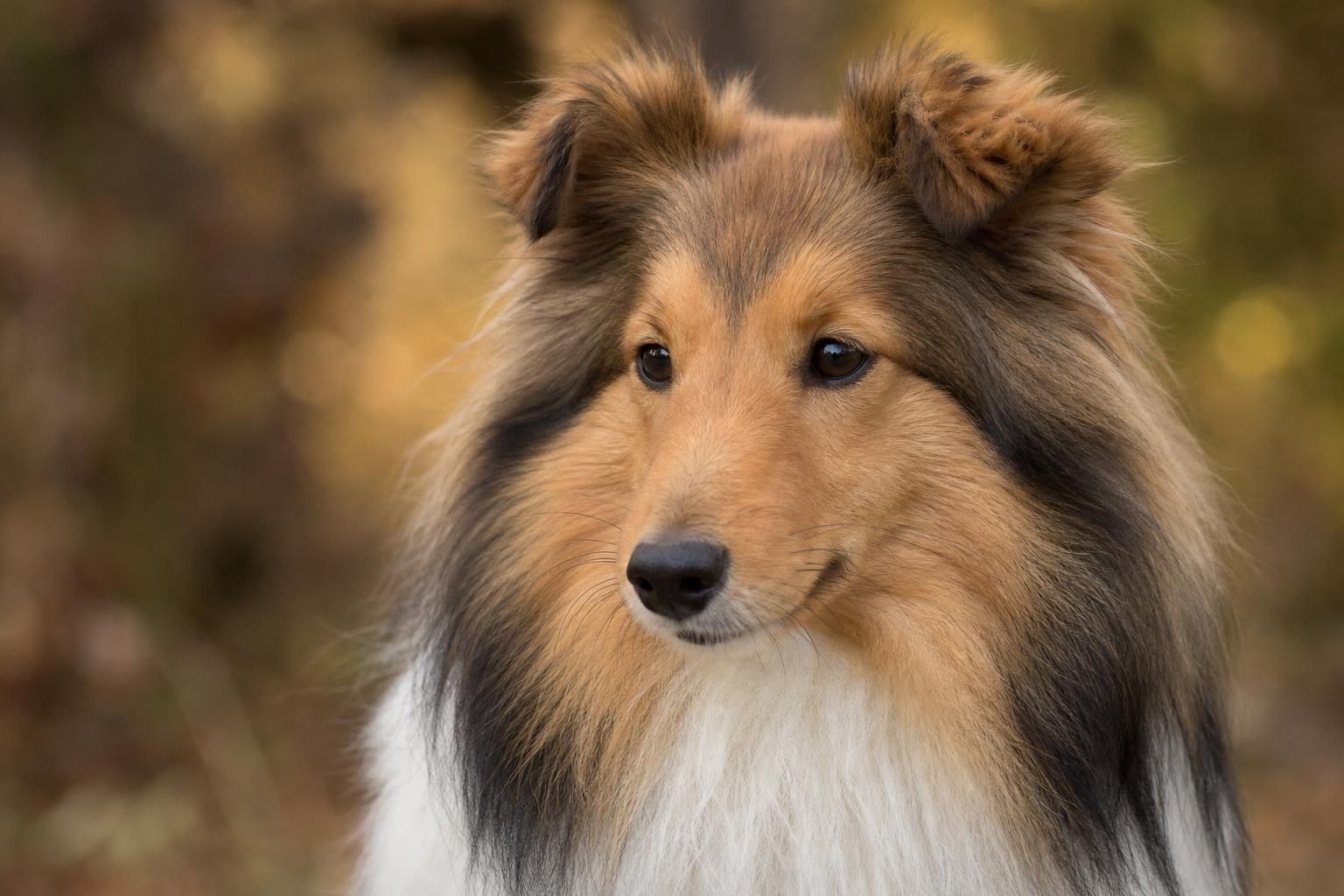
The head in the photo, a sable with a full white ruff, could belong to a dog of either background. That is rather the point: the label tells you less than the parents' measurements and the breeder's show record do.
What the difference means for a pet buyer
For most pet homes, the type matters less than people expect. A dog at 35 cm and a dog at 40 cm are both small, both double-coated and both need the same health tests. Size does change a few practical things: the amount of coat to brush, the crate you buy and how easily the dog fits on a lap.
If you want a smaller dog, ask the breeder the heights of both parents and of earlier puppies from the same pairing. That tells you far more than the word "English" on a website. Be wary of anyone selling a "toy" or "miniature" Sheltie: no such variety exists in any of the three standards.
Health comes before size whatever the type. MDR1, collie eye anomaly, von Willebrand disease type III and dermatomyositis affect the breed on both sides of the Atlantic, and the Sheltie health guide explains each test. The puppy guide has the questions to ask.
Imports, showing and the Canadian ring
Anyone planning to show in Canada needs a dog that measures inside the CKC range, because height is a disqualification here. A British import bred to the 37 cm ideal fits comfortably inside 33–40.75 cm. A large American dog right at 16 inches sits at the very top of the Canadian range and must not go over it.
Going the other way is harder. A Canadian dog at 40 cm would be well above the British ideal for a male, and a judge there could fault it heavily even though it is perfectly correct at home.
For a pet, none of this matters on registration papers: a puppy is a Shetland Sheepdog either way. The grooming and care guide is a better place to spend your planning time, since a dog near 40.75 cm carries a lot more coat than one near 33 cm. If size and coat are the main questions, the Cavalier or Sheltie comparison puts a smaller, silkier option alongside.
Next stopCavalier or Sheltie?