Start with the clubs, not the classifieds
The Canadian Shetland Sheepdog Association (CSSA) is the national parent club and works with the Canadian Kennel Club. Its members sign the CSSA Code of Ethics, and reading it before you contact anyone gives you a fair yardstick for every conversation that follows.
The CKC's Puppy List is the second stop. It is a searchable database of CKC member breeders, filtered by breed and province, and the CKC removes breeders who do not comply with its standards. A listing is not a health guarantee, though. The CKC itself suggests contacting the national breed club for referrals, which brings you back to the CSSA.
Regional clubs help most in the West. The CSSA lists member clubs in British Columbia, Alberta, Saskatoon and Winnipeg, mostly run through Facebook pages, and the Edmonton Shetland Sheepdog Fanciers Club, founded in 1968, has been a CKC member club since 1970. Club members are useful contacts for questions about local breeders, classes and events.
Ontario, Quebec and the Maritimes have no CSSA member club listed. Buyers there should expect to work through the national club and the Puppy List, and possibly to drive a long way to meet a litter. The Sheltie section overview has a fuller picture of the clubs.
Health results to see before you commit
Four DNA results and one eye exam cover the main inherited risks in the breed. The first is MDR1, a gene mutation that makes affected dogs dangerously sensitive to certain drugs. Washington State University puts its frequency in Shetland Sheepdogs at about 15 per cent, and testing is the only way to know. A breeder who knows the parents' status can tell you what the puppies could have inherited.
The UC Davis Shetland Sheepdog health panel includes collie eye anomaly (CEA), an inherited abnormal development of structures in the eye that ranges from mild to blinding, and von Willebrand disease type III, the most severe inherited form of that bleeding disorder. UC Davis also runs a dermatomyositis risk test based on three genetic markers. It gives a risk estimate, not a yes or no, so ask the breeder to explain how they use it in their pairings.
Eye exams are separate from DNA. The OFA's Companion Animal Eye Registry uses exams by a board-certified veterinary ophthalmologist, and a result is valid for 12 months, so look for a recent date on the parents' reports. More detail on each condition sits in the Sheltie health guide.
| Test | What it looks for | Who runs it |
|---|---|---|
| MDR1 | Drug-sensitivity gene mutation | WSU and other DNA labs |
| CEA | Inherited eye development defect | UC Davis panel |
| vWD type III | Severe inherited bleeding disorder | UC Davis panel |
| Dermatomyositis risk | Inherited skin and muscle disease | UC Davis test |
| Eye exam | Visible eye disease, checked yearly | Board-certified ophthalmologist |
Meeting the litter and the mother
Visit in person if you possibly can. A video call is a reasonable first step, but nothing replaces watching puppies move around their own space and seeing how the adults behave with a stranger in the kitchen.
Pay attention to the mother. The CKC standard describes the breed as intensely loyal, affectionate and responsive, and says a Sheltie may be reserved with strangers but should not be fearful. A mother who watches you from across the room and then comes over is within that description. One who hides, shakes or growls at a calm visitor is not, and her puppies grow up learning from her.
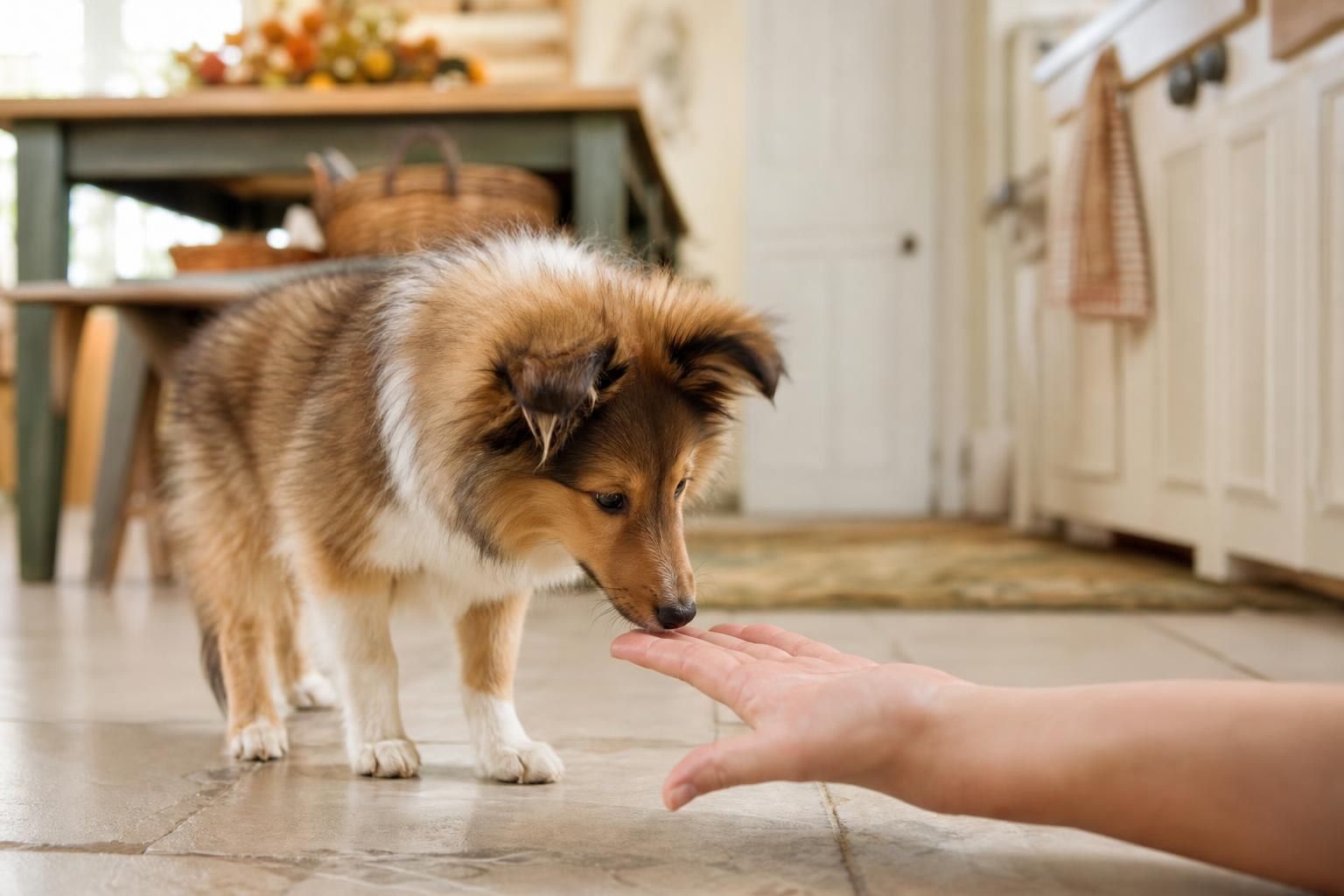
Look at the puppies as a group, then one at a time. Bright eyes, clean coats and easy movement are basic signs of care, as is a clean, warm area to sleep. A puppy that walks up to an offered hand, like the sable in the photo, shows confidence. A quieter one that comes over after a minute can be just as sound. Ask the breeder which puppy they think suits your household and why.
What a Sheltie puppy costs in Canada
Price data for the breed is thin. One Canadian price guide puts a puppy from a reputable breeder at roughly $2,000–$4,000, with shelter adoption around $500–$600. Treat both as rough guides rather than fixed rates, because prices depend on the breeder, the region and whether a puppy is sold as a companion or with show potential. Some breeders also describe a litter as American or English type; the American and English Sheltie page explains what that means for size.
Sheltie ads on Kijiji in October 2026 asked roughly $1,000 to $1,500, some of them for so-called miniature puppies. Some sellers are honest owners whose circumstances changed. Others are not, and a cheap price with no health results attached tells you nothing about the parents. Ask for the same paperwork you would from a breeder.
The puppy is only the first cost. A double-coated dog needs a good brush, a comb and the time to use them. Vet care, food and insurance follow. The cost calculator on the Cavalier price page uses Canadian figures for vet visits, food and insurance that give a reasonable feel for a small dog's first year.
Quebec and Ontario rules on selling puppies
Quebec has the clearest written rules. Under the regulation on the welfare and safety of domestic companion animals, in force since 10 February 2024, puppies must stay with their mother for at least 8 weeks, and young that are unweaned, unsocialised, visibly sick or malformed may be sold only if the seller discloses the problem beforehand and the buyer confirms it in writing. A dog may be bred from 18 months or her second heat, with no more than three litters in two years. The Quebec government page sets out the full list.
Ontario passed the Preventing Unethical Puppy Sales Act in 2024, which amends the Provincial Animal Welfare Services Act and prohibits operating a puppy mill. According to a summary by Animal Justice, the conditions it targets include separating puppies from their mothers before 8 weeks and breeding females under one year. The PAWS Act sets the minimum fine at $10,000, or $25,000 if a dog dies or has to be euthanized. Its in-force date is on Ontario's e-Laws site.
New Brunswick requires kennels that breed dogs to hold a licence renewed every year, and British Columbia holds commercial breeders to the CVMA kennel code; beyond that, this guide found no rule specific to puppy sales in the provincial law of other provinces. Eight weeks is still a sensible minimum anywhere in the country, and a breeder who wants to hand over a puppy earlier is a breeder to avoid. The provincial pages cover each region's animal welfare contacts.
Questions to ask a Sheltie breeder
A short list, asked politely, tells you most of what you need. Good breeders expect these questions and usually answer them before you ask.
- Are both parents tested for MDR1, CEA and vWD, and can I see the results?
- Has either parent had a dermatomyositis risk test, and how did it shape this pairing?
- When were the parents' eyes last examined by an ophthalmologist?
- Can I meet the mother, and the father if he lives here?
- Are you a CSSA member, and do you follow its Code of Ethics?
- At what age do puppies go home, and what comes with them?
- Will you take the dog back at any age if I cannot keep it?
Listen to how the answers are given as well as what they are. A breeder who is vague about test results, will not let you visit, always has puppies ready or sells several breeds from the same yard is showing you the usual warning signs. A breeder who asks about your schedule, your yard and who will do the brushing is doing the job properly.
Adopting an older Sheltie or a rescue dog
A puppy is not the only route. The CSSA publishes advice on adopting an older Sheltie, and an adult dog comes with a known size, coat and temperament. For a household that does not want months of house training, that can be the better choice.
In Ontario, the Southern Ontario Sheltie Rescue Society is a registered charity based in Burlington, established in 2003 according to its Halton community directory listing, that places dogs through a network of foster homes. It also takes Rough and Smooth Collies. No dedicated Sheltie rescue was found for BC, Alberta, Quebec or the Maritimes, so in those provinces the local SPCA and the national club are the places to ask.
Ask a rescue the same health questions you would ask a breeder, knowing some answers will be "unknown". An adult of unknown MDR1 status should be treated as possibly affected until a test says otherwise, and that is worth telling your vet at the first appointment.
The first weeks at home
The CSSA's Your New Puppy page is written for new owners and is worth reading before pickup day. Book a vet visit within the first week or two and bring the breeder's records, including the MDR1 result. The grooming and care guide explains how to get a puppy used to the brush while the coat is still short.
Vaccines follow your vet's schedule. The AAHA 2022 guidelines, widely used in North America, recommend at least three doses of the core combination between 6 and 16 weeks, and in Ontario every dog aged 3 months or older must be vaccinated against rabies under provincial law.
Last, read the CSSA's Lost Dog Guide before you need it. A small, quick herding dog that slips a collar in a February snowstorm is hard to spot against a white field, and a microchip plus a recent photo of the coat pattern make the search far easier.
Next stopSheltie healthWhere the facts come from
- Canadian Shetland Sheepdog Association: Code of Ethics
- Canadian Shetland Sheepdog Association: Your New Puppy
- Canadian Kennel Club: Puppy List
- Washington State University: MDR1 in dogs
- UC Davis Veterinary Genetics Laboratory: Shetland Sheepdog health panel
- OFA: eye certification (CAER)
- Gouvernement du Québec: obligations for breeding domestic animals
- Ontario: Provincial Animal Welfare Services Act, 2019
- Animal Justice: Ontario's new puppy mill law
- Le Bernard: Shetland Sheepdog price in Canada