
Why Cavalier King Charles Spaniel health needs a plan
A Cavalier is a small, sweet-natured dog with a short list of serious inherited conditions, and that list is unusually well studied. Mitral valve disease, a slow failure of one of the heart's valves, affects so many Cavaliers that specialists speak of lifetime prevalence rather than risk. Chiari-like malformation and syringomyelia, a problem of the skull and spinal cord, come second. Eyes, hips, kneecaps and two DNA-tested conditions make up the rest of a sensible screening plan.

None of this makes the Cavalier a poor choice. It means the parents' results matter more than coat colour or the shape of the head, and that a buyer who asks for paperwork is doing exactly what the breed clubs recommend. The breed profile covers temperament, size and lifespan. This page stays with the tests.
Start with the heart. It shapes most Cavaliers' later years.
Mitral valve disease: the Cavalier heart problem
Mitral valve disease (MVD) is a degenerative condition of the valve between the two chambers on the left side of the heart. As the valve thickens and stops closing cleanly, blood leaks backwards, and a vet hears that leak through a stethoscope as a murmur. In most breeds this is a disease of old age. In Cavaliers it often begins in early middle age.
The figures are stark. Cavalier Health, a long-running owner-run reference site in the United States, summarizes a 1993 US study of 394 dogs that found murmurs in 9 per cent of Cavaliers under one year old, 56 per cent of those under five and every dog aged ten or older. Swedish screening found murmurs in 52 per cent of six-year-olds in 2007 and 55 per cent in 2009. The same site quotes Professor Melanie Hezzell's view that lifetime prevalence approaches 100 per cent.
What differs from dog to dog is timing. A Cavalier whose murmur appears at three is on a very different path from one that stays clear until nine, and the breeding rules described below rest on the idea that early onset runs in families. If both parents, and ideally their own parents, stayed murmur-free into middle age, a puppy's odds improve. Nothing removes the risk entirely.
According to the Cavalier King Charles Spaniel Club of Canada, a University of Guelph study running since 1992 has found no DNA marker for MVD. Until one turns up, the stethoscope and the ultrasound probe are the only tools a breeder has.
Cold weather and a weak heart
SPCA winter advice lists dogs with medical conditions among those at greater risk in the cold, alongside toy breeds, puppies and older dogs. A Cavalier is a toy breed to begin with, so one with a diagnosed murmur belongs to two of those groups at once.
What a Cavalier heart murmur means for an owner
Hearing that your dog has a Cavalier heart murmur is unsettling, but a murmur is a finding, not a verdict. It tells the vet that the mitral valve has started to leak. On its own it does not say how much the heart has changed or how quickly the disease will move.
That gap is why the Cavalier King Charles Spaniel Club of Canada says a routine check at the family vet is not sufficient for screening. The club recommends an exam by a board-certified veterinary cardiologist from age one, combining auscultation (listening with a stethoscope) with echocardiography using colour Doppler, which shows the valve and the leak directly on screen. X-rays, in the club's view, belong to monitoring a dog that is already diagnosed rather than to screening a healthy one.
The club's advice is the same for a pet: book the first cardiologist exam from age one rather than wait. In practice many pet owners first meet a cardiologist only after a murmur turns up at a regular check-up, which leads to a referral and a baseline echocardiogram. After that first exam, repeat visits come at whatever interval the cardiologist sets. Keep every report in one folder. A breeder who follows the club's guidelines will want to hear about any early murmur in a dog they bred, because it changes their own plans.
In Ontario, the Ontario Veterinary College at Guelph runs a Cardiology Service offering echocardiography, X-ray, ECG and Holter monitoring. The service says it has two of only 25 board-certified specialists in veterinary cardiology in Canada, which tells you how thinly the specialty is spread across a very large country. Elsewhere, ask your regular vet for a referral to the nearest cardiologist; the provincial pages describe the local picture.
The MVD breeding protocol and Canadian guidelines
A set of expert guidelines published in 1998, known as the MVD Breeding Protocol, remains the rule book most serious Cavalier breeders quote. Its core points are short:
- breed only from dogs at least two and a half years old with no murmur;
- those dogs' parents should have been murmur-free at age five (the protocol also looks at grandparents);
- no Cavalier with a murmur before age five should be bred;
- every breeding dog is examined each year by a cardiologist.
The Breeders' Guidelines of the Cavalier King Charles Spaniel Club of Canada repeat the same thresholds, and annual cardiac checks are common among its breeders. The club's Health and Education Committee is considering an annual heart clinic, so its website is the place to check whether one has been scheduled near you.
Does screening work? Denmark's experience says yes, with a condition attached. A mandatory Danish scheme that combined auscultation with echocardiography significantly reduced the prevalence of the disease within eight to ten years, while the UK's auscultation-only scheme proved less effective. The lesson for a Canadian buyer is direct: ask for cardiologist reports that include an echo, not a note saying a vet heard nothing.
In the United States, the ACVIM's ARCH registry certifies hearts as clear of MVD, and most cardiologist-run heart clinics there offer registration. A Canadian cardiologist's written report carries the same information without the registry number.
A heart and screening timeline for a breeding Cavalier
- Any ageDNA testsEpisodic falling and dry eye curly coat, once
- 1 yrFirst cardiologist examAuscultation plus colour Doppler echo
- 1–3 yrsMRI grade letter cIf the dog is scanned for CM/SM
- 2½ yrsEarliest breeding ageOnly with no murmur
- YearlyHeart and eyes againCardiologist and ophthalmologist
- 5 yrsThe parents' testParents should still be murmur-free
Chiari-like malformation and syringomyelia
Chiari-like malformation (CM) is a mismatch between skull and brain: the back of the skull is too small for what it holds. Syringomyelia (SM) is what can follow, with fluid-filled cavities forming in the spinal cord of the upper neck. The two are screened together, and the BVA lists them as suspected inherited in King Charles Spaniels as well, a point the page on Cavaliers and King Charles Spaniels picks up.
The scale of the problem shows in a twelve-year Dutch screening study of 1,020 Cavaliers. Every dog scanned had CM. Syringomyelia was found in 39 per cent, and the share rose with age. A 2016 presentation at a European animal science conference put syringomyelia at up to 70 per cent in some Cavalier populations, so the Dutch figure is not a worst case.
Screening means MRI. Under the UK's BVA/Kennel Club CM/SM Scheme, a scan of the brain and upper neck is graded by BVA scrutineers on two scales, CM 0 to 2 and SM 0 to 2, where lower is better, plus a letter for the dog's age at the scan: c for one to three years, b for three to five, a for over five. The scheme confirms the conditions are inherited in Cavaliers and Griffon Bruxellois, charges £100 per dog on top of vet and MRI fees, and is open to all dogs. It does not explain how dogs outside the UK take part, so a Canadian breeder may hold a report from a local specialist rather than a BVA grade.
An MRI needs a general anaesthetic and a specialist centre, which puts a real price on every scan. Ask whether the parents were scanned, at what age and with what result. Because syringomyelia tends to appear later, an SM 0 on a parent scanned after five tells you more than the same grade at fourteen months.
Eyes, hips and kneecaps
Eye screening in North America runs through the Orthopedic Foundation for Animals' Companion Animal Eye Registry, known as CAER. A board-certified veterinary ophthalmologist (a diplomate of the ACVO) examines the eyes, and the result is valid for 12 months, so the OFA recommends a fresh exam every year.
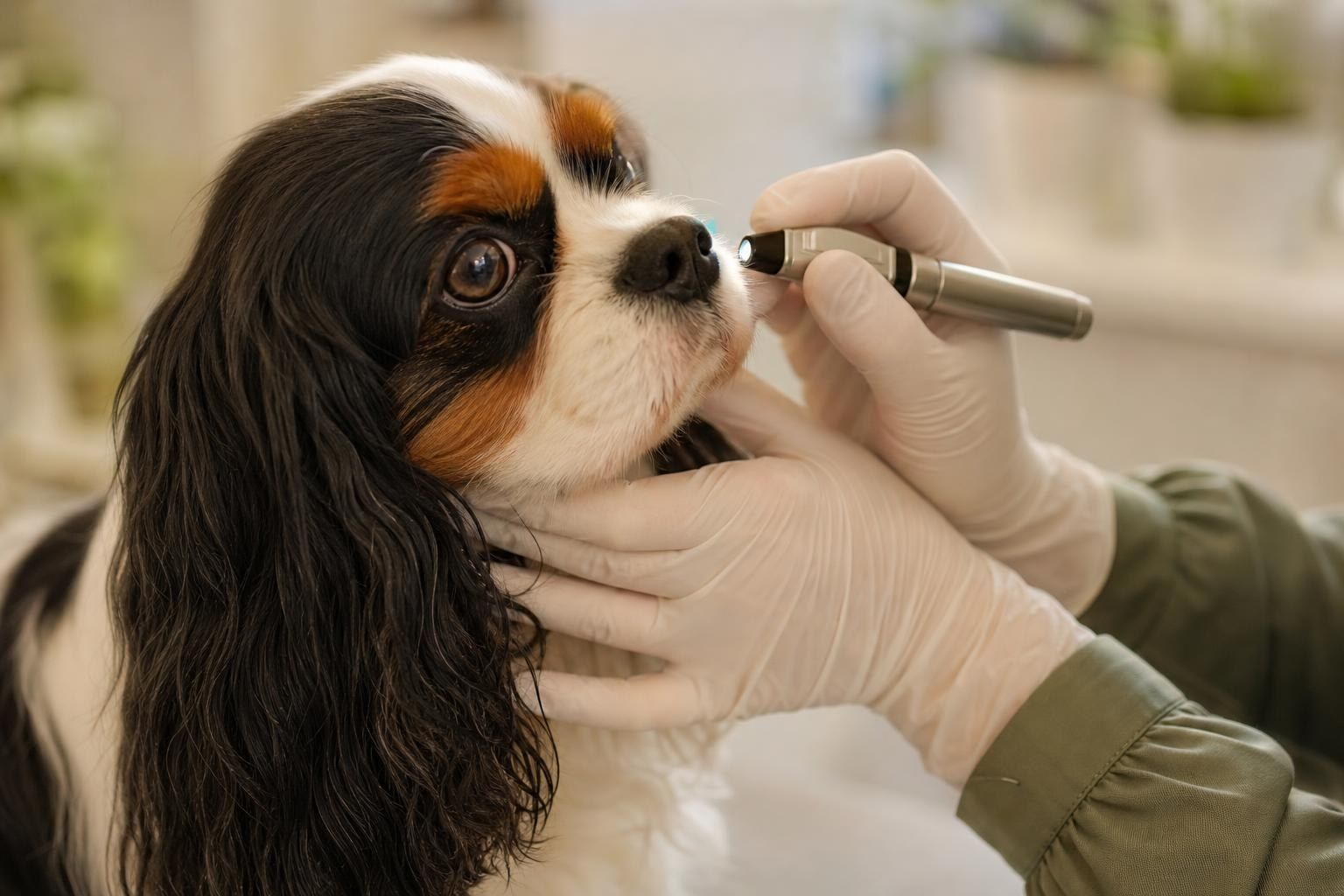
Which eye conditions turn up most often in Cavaliers is less well measured than heart disease, and published figures vary. For a buyer the practical point is simpler: both parents should have a CAER form dated within the past year. The national club keeps a page on eyes among its health topics.
Hips and kneecaps come next. The American Kennel Club lists four tests recommended by the breed's US national club: patella evaluation, hip evaluation, cardiac exam and ophthalmologist evaluation. The US breed club's own guidelines ask for a heart clearance from a board-certified cardiologist at a minimum of two and a half years, a normal eye exam by a board-certified ophthalmologist, no patellar luxation on a licensed vet's exam and a passing OFA hip X-ray.
Patellar luxation means a kneecap that slips out of its groove. A vet can check it during an ordinary physical exam, which makes it one of the easiest results to ask about.
DNA tests for episodic falling and dry eye curly coat
Two Cavalier conditions have straightforward DNA tests, and the Cavalier King Charles Spaniel Club of Canada points to both. Because a dog's DNA does not change, each test only needs doing once.
Episodic falling syndrome (EFS) is caused by a deletion in the BCAN gene and is recessive, so a puppy is affected only when it inherits the faulty copy from both parents. Episodes can begin anywhere from 14 weeks to four years of age, and dogs stay conscious throughout. In a US sample of unaffected Cavaliers, 12.9 per cent turned out to be carriers.
Dry eye curly coat syndrome is linked to a deletion in the FAM83H gene. Affected puppies are born with a rough, curly coat and develop dry eye as soon as their eyelids open, at 10 to 14 days. Signs show so early that the test's real job is to stop two carriers being mated in the first place.
Carriers are healthy dogs. For a recessive condition like EFS, a carrier mated to a clear dog cannot produce an affected puppy, so a breeder who keeps a carrier in the program can still be acting responsibly. The question is never "is this dog a carrier?" on its own. It is "what are both parents' results?"
Ear trouble (PSOM) and what remains uncertain
Primary secretory otitis media, often called glue ear, is a build-up of thick mucus in the middle ear. MRI or CT is the most reliable way to confirm it, and both need anaesthesia.
A 2024 MRI screening study of Dutch and Danish Cavaliers in Frontiers in Veterinary Science, mainly about syringomyelia, noted glue ear in many of the scanned dogs and said its clinical significance is unclear. Researchers including Lugones, Loughin and Marino have studied how common it is, and a vet who sees the breed often can say how it shows up in practice. Treat firm numbers quoted elsewhere with some care.
PSOM is a useful reminder that a health-tested Cavalier is a dog with better odds, not a guaranteed one. Pet insurance taken out while a puppy has no findings on its record is worth pricing early, and the Cavalier cost calculator has a line for it.
Health certificates to ask a breeder for
Put together, the Cavalier King Charles Spaniel health screening plan for a breeding dog fits on one page. A breeder should be able to show you every line of it for both parents, with the dog's name and the exam date on each report. The full visit checklist sits in the guide to finding a Cavalier breeder.
Two habits make the paperwork worth reading. Ask for the cardiologist's own report rather than a summary, and look at the date, because a heart that was clear at two is not the same as a heart that was clear at five. Then ask about the grandparents if the breeder knows them, since the 1998 protocol looks back that far.
Once a puppy is home the schedule carries on: first-year puppy care covers vaccines and early vet visits, and the first cardiologist appointment falls around the first birthday.
| Test | Who performs it | When and how often |
|---|---|---|
| Heart (auscultation and echo) | Board-certified veterinary cardiologist | From age 1, then every year |
| Eyes (CAER) | Board-certified ophthalmologist (ACVO) | Valid 12 months; repeat yearly |
| CM/SM (MRI) | Specialist MRI centre; BVA scrutineers in the UK scheme | Graded by age: 1–3, 3–5, over 5 |
| Hips | Vet X-ray, evaluated by the OFA | Before breeding |
| Patellas | Licensed veterinarian | Before breeding |
| EFS and dry eye curly coat | DNA laboratory | Once in the dog's life |
Where the facts come from
- Cavalier King Charles Spaniel Club of Canada: Heart, mitral valve disease and testing
- Cavalier King Charles Spaniel Club of Canada: Health
- Cavalier Health: Mitral valve disease
- Cavalier Health: MVD Breeding Protocol
- Swedish and Danish MMVD screening data (PMC)
- OVC Cardiology Service, University of Guelph
- BVA: CM/SM Scheme
- Utrecht University: Twelve years of CM/SM scanning in Cavaliers
- OFA: Eye certification (CAER)
- AKC: Toy Group health testing requirements
- Episodic falling syndrome in Cavaliers (PMC)
- Dry eye curly coat syndrome and FAM83H (PMC)
- Frontiers in Veterinary Science: MRI screening study in Dutch and Danish Cavaliers (2024)