
Few toy breeds are as easy to like on a first meeting. A Cavalier will usually walk straight up to a stranger, tail going, and settle against the nearest leg. That openness is written into the breed standard, and it is also why the dog has become one of the most familiar small companions in Canadian homes. The harder questions come later: how long they live, what they cost to keep healthy, and how a silky little spaniel copes with February in Edmonton.
Cavalier King Charles Spaniel temperament: what the standard promises
The Canadian Kennel Club standard asks for a dog that is fearless and sporting in character, yet gentle and affectionate. The UK Royal Kennel Club standard describes the breed as gay, friendly, non-aggressive, with no tendency to nervousness. Under characteristics it adds three more words: sporting, affectionate, absolutely fearless. The UK's six words cover the Cavalier King Charles Spaniel temperament better than most long descriptions do.
In daily life this usually means a dog that likes people more than it likes being left alone. Visitors are greeted, not challenged. Children are generally tolerated with patience, although any small dog needs protecting from rough handling, and a toy breed dropped from arms can be badly hurt.
Do not mistake gentle for lazy. "Sporting" is in the standard for a reason: there is real spaniel underneath, with a nose that wants to follow a scent across a park and a soft mouth that loves a game of fetch.
The flip side is short. A Cavalier is a hopeless guard dog. If you want a dog that warns off strangers at the door, this breed will disappoint you within a week.
Fearless is not the same as tough
The standard's 'absolutely fearless' describes attitude, not size. A dog of 6 or 7 kg will happily approach a much larger one, so recall and a leash in busy dog parks matter.
Size: how big do Cavalier King Charles Spaniels get?
It depends partly on which standard you read. The Canadian Kennel Club standard (Group V, Toys, effective July 2019) gives a height of 30.5–33 cm (12–13 in) and a weight of 6.25–8.25 kg (14–18 lb). The UK Royal Kennel Club gives a weight of 5.4–8.2 kg (12–18 lb) and adds that a small, well-balanced dog well within these weights is desirable. It sets no height at all. The American Kennel Club gives both: 30–33 cm (12–13 in) at the withers and 5.9–8.2 kg (13–18 lb).
So how big do Cavalier King Charles Spaniels get in a normal pet home? Most adults sit somewhere in that overlapping band, roughly the weight of a large house cat but longer in the leg and much fluffier in outline. The feathering on the ears, chest and legs makes them look bigger than they are; lift one and the difference is obvious.
The CKC and AKC agree closely on height, and the CKC sets a heavier lower weight limit than either the UK or the AKC. The breed standard page sets all three side by side.
Size has a practical side in Canada. A dog of this size sits comfortably in a condo, rides easily in a car crate and can be carried over a slushy curb. It also loses body heat quickly, which matters more than most new owners expect.
Cavalier lifespan: why the published numbers disagree
Ask three sources about Cavalier lifespan and you will get three answers. Breed summaries that reproduce AKC data quote 12–15 years. A large UK study using VetCompass veterinary records from the Royal Veterinary College, covering more than 30,000 dogs across many breeds, put Cavalier life expectancy at birth at about 10.45 years. An older VetCompass poster based on 121 Cavaliers found a median of 9.99 years.
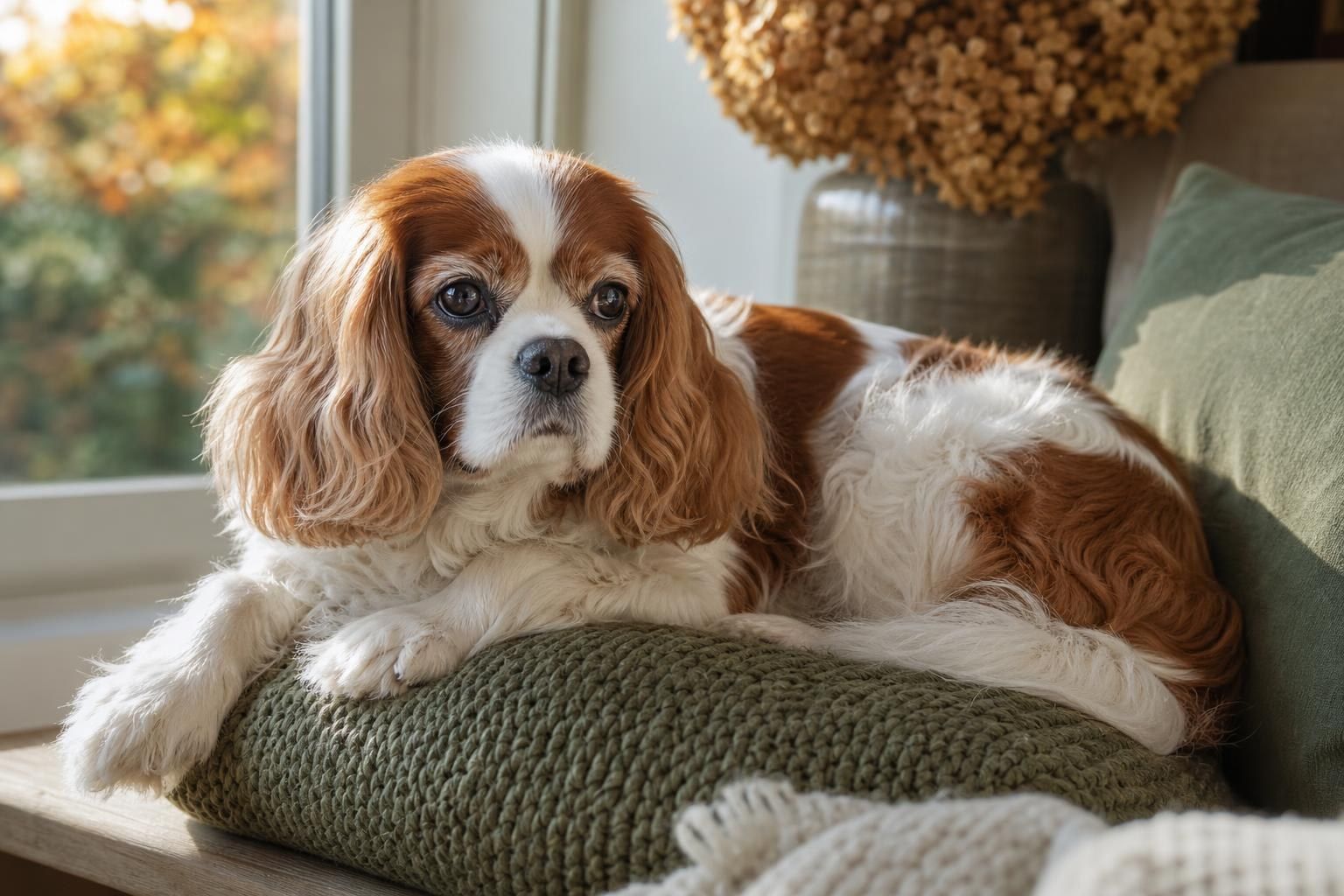
The fair summary is around 10–14 years, with UK vet-record data suggesting about 10½ on average. That is shorter than many other toy breeds, and the reason is mostly the heart.
The practical advice is blunt. Budget and plan for a dog that may need cardiology visits and medication in middle age, and treat anything beyond 12 as a gift. Owners who go in with that expectation tend to cope far better than those who were promised 15.
Lifespan is also where breeding choices show. A puppy from parents screened by a cardiologist does not come with a guarantee, but it starts with better odds than one from untested stock.
From royal paintings to the Canadian Kennel Club
The modern breed is younger than it looks. In 1926 an American, Roswell Eldridge, offered prizes at Crufts for "Blenheim spaniels of the old type", meaning the longer-nosed, flat-skulled toy spaniels seen in paintings from the reign of Charles II. Blenheim is still one of the four recognized colours, and the colour guide shows all four. By then the fashionable King Charles Spaniel had a short, pushed-in face, and Eldridge wanted the older look back. He offered prizes of £25 for the best dog and best bitch and announced that the arrangement would run for five years.
According to the AKC, Eldridge died less than a year after placing his advertisement, so he never saw the Crufts show of 1928 where enthusiasts founded the breed club and settled on the name Cavalier King Charles Spaniel. The UK Kennel Club recognized the Cavalier as a separate breed in 1945.
Canada was early. The Canadian Kennel Club recognized the breed in 1957 and places it in Group V, Toys. The American Kennel Club took much longer: the Cavalier became its 140th breed in 1996. The national club here, the Cavalier King Charles Spaniel Club of Canada, was founded in 1973 and is the parent club recognized by the CKC. Its 2027 National Specialty is set for 17–19 September 2027 in Terrebonne, Quebec.
The split from the older breed explains a lot of confusion at the dog park. The Cavalier and the King Charles Spaniel are separate breeds, and in Canada the second one is registered as the English Toy Spaniel.
Key dates
- 1926Eldridge prizesCrufts classes for the old type
- 1928Breed club foundedName chosen at Crufts
- 1945UK recognitionSeparate breed at the Kennel Club
- 1957CKC recognitionGroup V, Toys
- 1973Canadian clubNational club founded
- 1996AKC recognition140th AKC breed
Exercise and play for a sporting toy
A Cavalier does not need the mileage of a herding dog, but a single trip to the end of the driveway is not enough either. Daily walks with real time to sniff, rather than a quick loop of the block, suit most adults. Off-leash play in a fenced area adds the kind of free running a spaniel enjoys.

The nose drives a lot of the behaviour. A scent trail along a lakeshore or a ravine path can make a usually biddable dog suddenly deaf, so recall training is worth starting early. Scent games indoors are a good substitute on days when the windchill makes a long walk unkind.
Many Cavaliers do well in obedience, rally and agility at a modest level. Weight matters here: a lean dog moves more freely and puts less load on joints and heart, and the breed's enthusiasm for food makes extra kilos easy to gain.
Once a dog has a heart murmur, ask the vet or cardiologist how hard it should be exercised, because the answer changes as the disease progresses.
Living with a Cavalier through a Canadian winter
Canadian winters vary a great deal. The January mean is about −6.3 °C in Toronto, −10.4 °C in Montréal and −13.5 °C in Edmonton, while Vancouver sits at 3.3 °C and a lot of rain (Environment Canada normals, 1971–2000). A small dog close to the ground feels all of it sooner than you do.
Road salt is the everyday problem. The BC SPCA warns that the salt and ice melt used on sidewalks can hurt a dog's paws, and advises cleaning them with warm water and towel-drying them after walks. The Ontario SPCA suggests booties and wiping the paws and underside with a damp towel when you get home. Cavaliers grow long hair between their pads, which holds ice balls, so trimming that hair is part of the grooming routine.
Frostbite most often affects ears, tail and paws, and the SPCAs single out toy breeds, puppies, older dogs and dogs with medical conditions. Because of heart disease, that last group includes a large share of older Cavaliers. A coat for walks in deep cold is sensible, not a fashion statement. Antifreeze is worth a mention too: the BC SPCA calls it extremely poisonous to pets and notes that it tastes sweet.
The province pages under Cavaliers in Canada go into local climate, rules and contacts, from chinook swings in Calgary to wet coastal winters.
The heart question every owner has to face
Mitral valve disease (MVD) is the breed's defining health problem. Figures collected by the owner-run resource Cavalier Health suggest that more than half of Cavaliers have an MVD murmur by age 5 and over 90 % by age 10. Not every murmur becomes heart failure, and some dogs live with one for years, but no buyer should assume their dog will be the exception.
The Cavalier King Charles Spaniel Club of Canada recommends screening by a cardiologist from age 1, using auscultation plus echocardiography; a routine vet visit is not considered sufficient. Its breeders' guidelines follow the long-standing MVD protocol: breed only dogs at least 2.5 years old and murmur-free, whose parents were murmur-free at 5. In Ontario, the OVC Cardiology Service at the University of Guelph offers echocardiography and other heart tests.
Hearts are not the only issue. A Dutch screening study of 1,020 Cavaliers found Chiari-like malformation in all of them and syringomyelia in 39 %, rising with age. Eyes, hips and knees are also on breed-club test lists. The health testing guide explains each test and when it is done.
Ask for the cardiologist's report
A breeder's 'vet checked' is not a heart clearance. The national club's guidance is a cardiologist exam with echocardiography, and you can ask to see the dated results for both parents.
Who the breed suits, and who should look elsewhere
A Cavalier suits people who want a dog in the room with them. Retired couples, families with gentle older children, first-time owners and condo dwellers all tend to do well, provided someone is home for a good part of the day. How big do Cavalier King Charles Spaniels get next to a one-bedroom condo? Small enough that space is rarely the problem; time at home is. A breed built around company is a poor match for a house that sits empty ten hours at a stretch.
It also suits owners who can carry the cost of a breed with known health risks. A puppy from a health-testing breeder runs roughly $2,000–$4,000 or more in Canada, and cardiology exams are a Cavalier-specific line on top of the usual bills. The cost calculator breaks down a first year.
If that still sounds right, the next steps are finding a breeder through the CKC Puppy List or the national club's directory, or looking at rescue and adoption, which mostly means older dogs. The breeder guide has the questions to ask, and the puppy care guide covers the first weeks at home. Crosses such as the Cavapoo are a separate question, covered on the Cavalier mixes page.
Still deciding between breeds? The Cavalier or Sheltie comparison puts the two side by side, coat, size, energy and health. The Sheltie carries a double coat that sheds heavily by season.
Next stopBreed standardWhere the facts come from
- Royal Kennel Club: Cavalier King Charles Spaniel breed standard
- American Kennel Club: Cavalier King Charles Spaniel history
- Canadian Kennel Club: Cavalier King Charles Spaniel breed standard (PDF)
- Cavalier King Charles Spaniel Club of Canada: heart and mitral valve disease testing
- RVC VetCompass: Cavalier longevity poster (2012)
- Scientific Reports: life tables for UK companion dogs (VetCompass, 2022)
- Cavalier Health: mitral valve disease
- BC SPCA: cold weather care guide
- Ontario SPCA: cold weather pet safety tips
- Utrecht University: twelve years of CM/SM screening in Cavaliers
- Statistics Canada: average daily temperatures by month, 1971–2000 (Environment Canada normals)