Why a written standard matters to a pet owner
Every recognized breed has a standard: a short document that describes how the dog should look, move and behave. For the Cavalier there are three that matter to Canadians. The UK Royal Kennel Club standard is the original, last updated in April 2025. The Canadian Kennel Club, which recognized the breed in 1957 and places it in Group V, Toys, publishes its own version, effective July 2019, with its own height and weight figures. The American Kennel Club standard governs dogs shown south of the border, and many Canadian breeders show there too.
None of this is only for show people. The standard explains why a Cavalier's coat is never clipped, why some colours are rarer than others, and why a dog that growls at visitors is a long way from type.
The numbers below come from all three standards, which each club publishes in full online. Where they differ, all three are shown.
A reading tip. Standards are written in old-fashioned dog-show language, and words like "gay" or "sporting" carry their older meanings. Read the whole thing once, then come back to the parts that puzzle you.
The head: a flat skull and the famous lozenge
The head is where the Cavalier parts company with its close relative. When Roswell Eldridge offered prizes at Crufts in 1926, he asked for Blenheim spaniels of the old type: a longer nose and a flat skull, as in paintings from the time of Charles II. The modern standard keeps that idea. The skull is flat, and the muzzle is noticeably longer than the short, upturned face of the King Charles Spaniel, whose skull is domed.
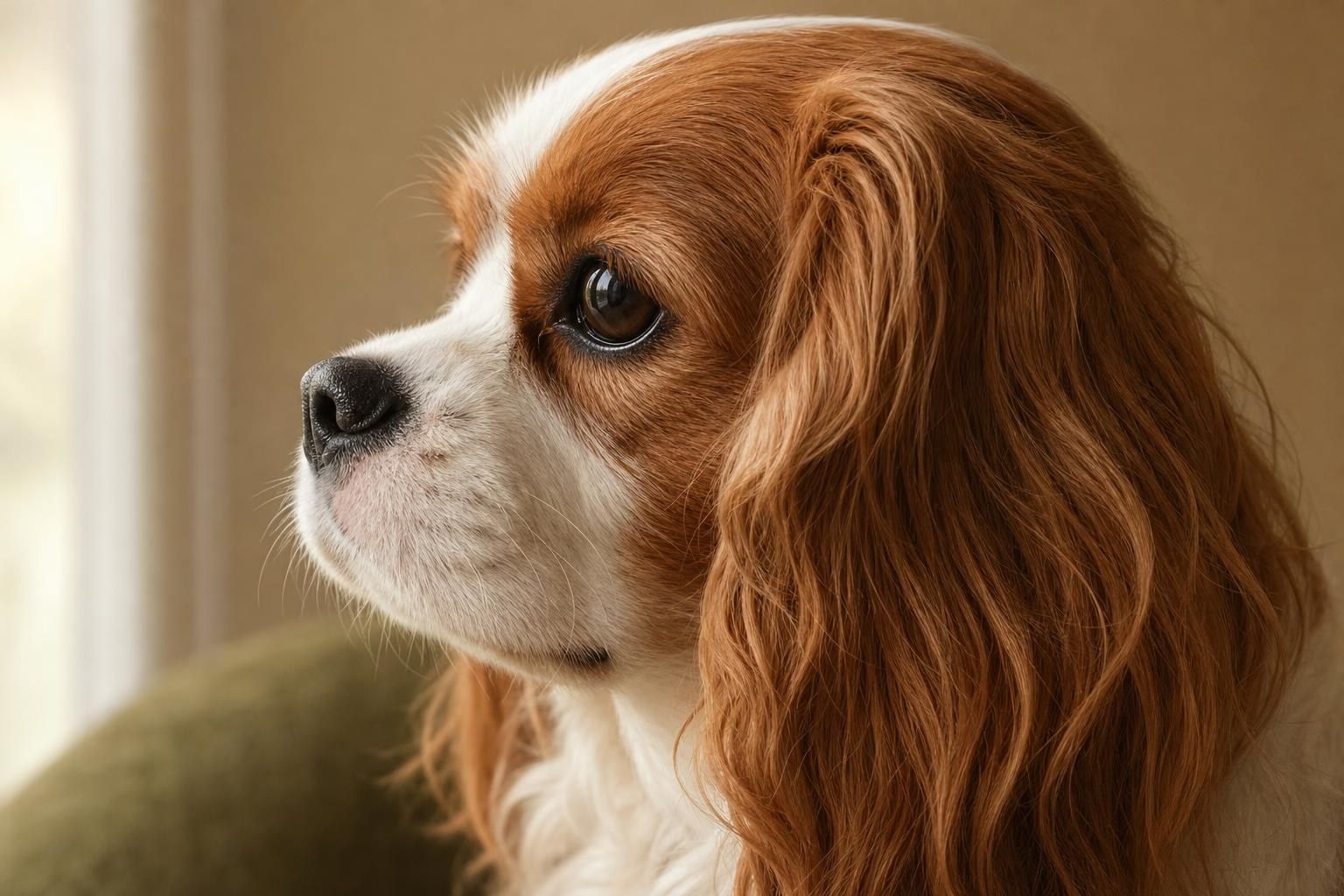
If you hold the two breeds' heads side by side, the difference is obvious within seconds. The Cavalier's face looks open and soft; the older breed's face looks rounder and more compact.
Then there is the lozenge. In Blenheim dogs, the UK standard asks for the head markings to be well divided, leaving room between the ears for the "much valued" lozenge mark or spot, which it calls a unique characteristic of the breed. It is a small chestnut patch in the white blaze on top of the head. Plenty of excellent Blenheims do not have one, and it has nothing to do with health.
The long ears carry heavy feathering, which frames the face and gives the breed its gentle expression. That same feathering is a grooming job, covered on the grooming page.
Coat and feathering, left as it grows
The UK standard asks for a long, silky coat, free from curl, with a slight wave allowed and plenty of feathering. Then comes the line that shapes every Cavalier owner's grooming routine: the coat should be totally free from trimming. The CKC standard says the same, with one exception: the underside of the paws may be trimmed for health and safety.
In the show ring that is taken literally. No scissored outline, no shaped feet, no tidied ears. Pet owners have more freedom, and most trim the hair under the feet for hygiene and grip, particularly in a Canadian winter when long foot hair collects ice and salt.
A tight curl in the coat is not what the standard describes. A curly, harsh or very sparse coat on a puppy sold as a pure Cavalier is worth asking about, because one rare inherited condition, dry eye curly coat syndrome, shows a rough coat from birth. A DNA test exists for it, and the health testing guide explains what to ask for.
Four colours, and only four
The UK standard names four colours: Blenheim (rich chestnut on pearly white), tricolour (black and white with tan markings), ruby (whole-coloured rich red) and black and tan (raven black with tan markings). Any other colour or combination is unacceptable. The CKC standard lists the same four and makes any other colour a disqualification.
Breeders group them into particolours, the two with white, and wholecolours, the two without.
For pet buyers the practical point is simple: a "rare" colour outside these four is not a selling point, and it may mean the puppy is not purebred. The colours guide covers each one in detail, with notes on markings and mismarks.
Weight and height: the CKC, UK and AKC figures side by side
The CKC standard gives a height of 30.5–33 cm (12–13 in) and a weight of 6.25–8.25 kg (14–18 lb), and says a small, well-balanced dog well between these heights and weights is desirable. The UK standard gives a weight of 5.4–8.2 kg (12–18 lb) and adds that a small, well-balanced dog well within these weights is desirable. It gives no height. The AKC standard asks for 30–33 cm (12–13 in) at the withers and a weight of 5.9–8.2 kg (13–18 lb), a slightly heavier lower limit than the UK's.
The phrase "well-balanced" does a lot of work. A Cavalier should look like a small sporting spaniel in proportion, not a tiny dog on stilts or a long dog on short legs. Balance is easier to judge with the eye than with a scale, which is why good breeders talk about it constantly.
For a pet, weight matters for a different reason. A Cavalier that has drifted well past the top of the range carries extra load on its heart and joints, and the breed's appetite makes that easy. Ask your vet to show you how to feel the ribs, which beats any number on a chart.
| Point | Canadian Kennel Club | UK Royal Kennel Club | American Kennel Club |
|---|---|---|---|
| Weight | 6.25–8.25 kg (14–18 lb) | 5.4–8.2 kg (12–18 lb) | 5.9–8.2 kg (13–18 lb) |
| Height | 30.5–33 cm (12–13 in) | Not specified | 30–33 cm (12–13 in) |
| Size guidance | Small, well balanced, well between the heights and weights | Small, well balanced, well within the weights | Height and weight both stated |
| Group | Group V, Toys | Toy | Toy Group |
| Recognized | 1957 in Canada | 1945 as a separate breed | 1996, 140th breed |
Temperament, as the standard writes it
The CKC standard gives the temperament in one line: fearless and sporting in character, yet at the same time gentle and affectionate. The UK standard describes the temperament as gay, friendly and non-aggressive, with no tendency to nervousness. Its list of characteristics reads sporting, affectionate, absolutely fearless. Those words are not decoration. A judge can fault a dog that cowers from the hand or snaps, however pretty it is.
That matters to buyers. When a breeder explains why a particular dog was never bred, temperament is a perfectly good reason, and arguably the best one. A nervous Cavalier is harder to live with than a mismarked one.
The breed profile covers what this temperament looks like at home, from greeting visitors to coping with children.
Pet or show puppy: what the label means
Breeders who show often sort a litter into show prospects and pet puppies. The difference is almost always cosmetic: markings that are uneven, a lozenge missing, a coat or head that is good but not exceptional, or a size likely to finish outside the ideal. A pet puppy is not a second-class dog.
What should not differ is health. The parents of a pet puppy should have the same heart, eye and other screening as the parents of a show puppy, because they are the same parents. If a seller offers a cheaper "pet" option because the health testing was skipped, that is a warning, not a discount.
Price can differ. One Canadian pet-insurance guide puts puppies from reputable breeders at about $2,000–$3,500, with show-bred dogs up to around $4,500. The price and cost page sets out a first-year budget.
Ask too about registration. The Cavalier King Charles Spaniel Club of Canada advises confirming CKC registration for both parents and the puppy, and some pet sales come with a non-breeding agreement. The breeder guide covers contracts in more detail.
Read the contract
A pet sale may carry non-breeding or spay and neuter terms. These are normal, but read them before the deposit changes hands, not on pickup day.
Seeing the standard in the flesh
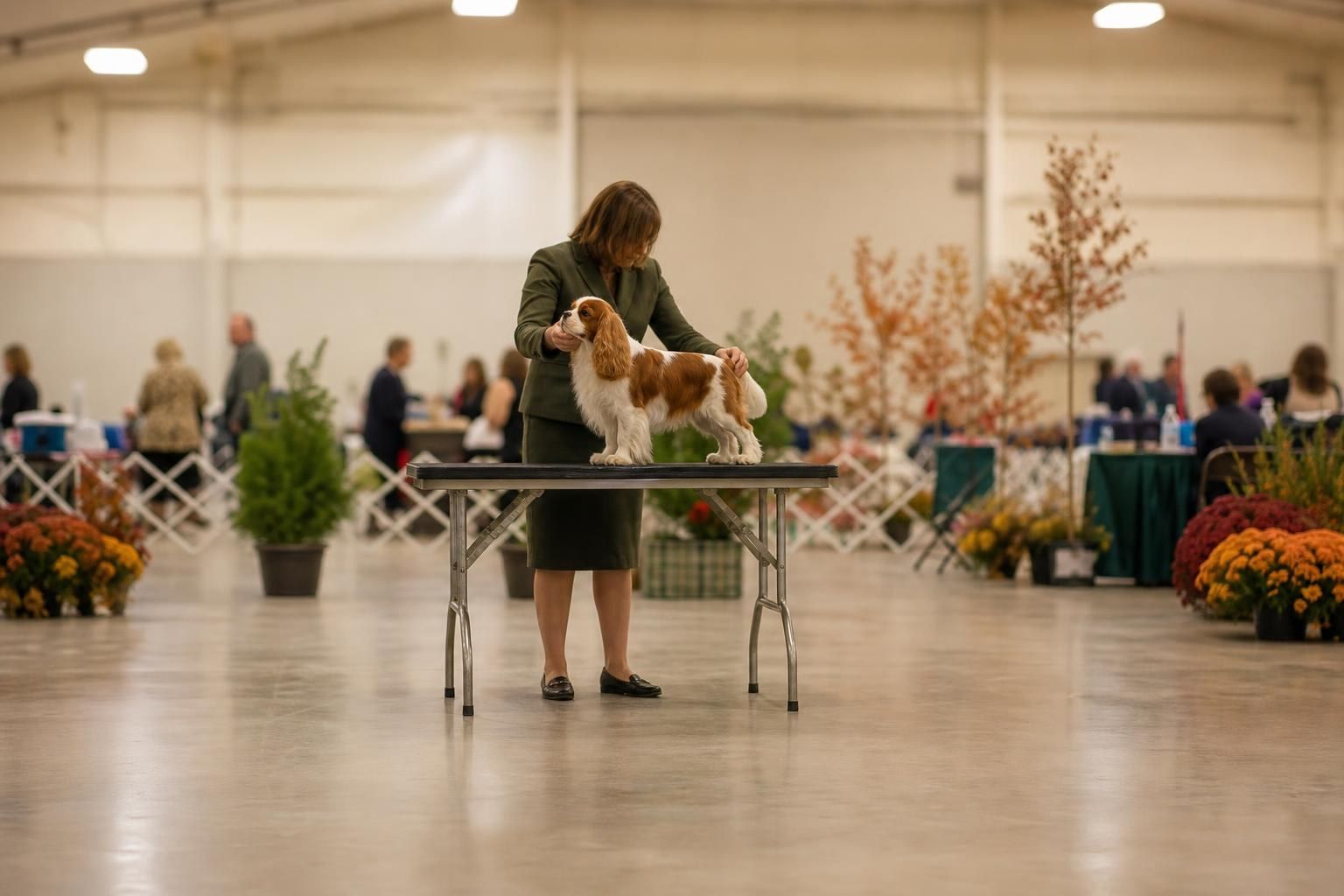
The fastest way to understand a standard is to watch a judge apply it. CKC-sanctioned shows run across the country, and a breed ring full of Cavaliers shows the four colours, the flat skull and the untrimmed coat in a way no photo can.
The national club holds an annual National Specialty, a show for Cavaliers only. The 2027 edition is set for 17–19 September 2027 in Terrebonne, Quebec. Regional clubs such as the Cavalier Fanciers of Southern Ontario and the CKCS Club of BC are listed by the national club, and the province pages list what exists near you.
It also helps to see the older breed in the same building. An English Toy Spaniel standing near a Cavalier makes the head difference plain; the Cavalier vs King Charles page explains it. Exhibitors between classes are usually happy to talk, as long as you wait until their dog has been judged.
Next stopColoursWhere the facts come from
- Royal Kennel Club: Cavalier King Charles Spaniel breed standard
- Canadian Kennel Club: Cavalier King Charles Spaniel breed standard (PDF)
- American Kennel Club: Cavalier King Charles Spaniel
- American Kennel Club: Cavalier King Charles Spaniel history
- Cavalier King Charles Spaniel Club of Canada: National Specialty
- Spot Pet Insurance Canada: how much does a Cavalier cost