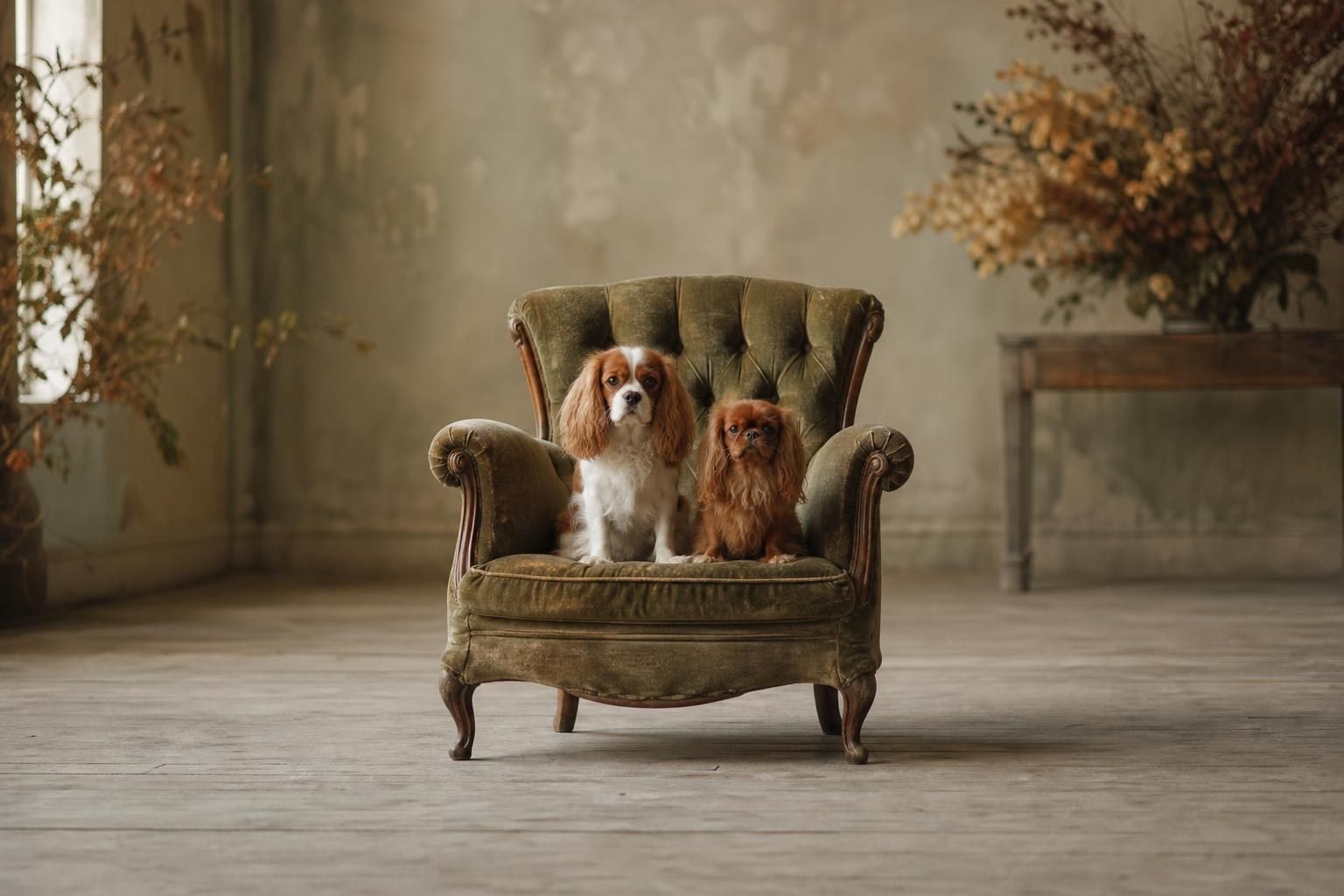
Two breeds that share a past
For a long time there was only one breed: the small toy spaniels seen on the laps of the court in paintings from the reign of Charles II. Over time breeders favoured a shorter, flatter face and a rounder, domed skull. By the early twentieth century that was the accepted look of the King Charles Spaniel.
In 1926 an American visitor, Roswell Eldridge, offered prizes at Crufts for "Blenheim spaniels of the old type", meaning dogs with the longer nose and flat skull of the old paintings. He promised to keep the prizes going for five years. The breeders who took up the challenge founded a club in 1928 and called their dogs Cavalier King Charles Spaniels. The UK Kennel Club recognized the Cavalier as a separate breed in 1945.
So the Cavalier is, in a sense, the younger breed recreating the older look, while the King Charles Spaniel kept the later fashion. That is why the names overlap and why so many people mix them up.
The name problem: King Charles or English Toy Spaniel?
In the UK the older breed is the King Charles Spaniel. In Canada and the United States it is registered as the English Toy Spaniel. Both the Canadian Kennel Club and the American Kennel Club use that name, and the CKC places it in Group V, Toys, alongside the Cavalier.
That gives Canadian buyers a simple rule. If an advertisement here says "King Charles Spaniel", ask whether it means a Cavalier or an English Toy Spaniel. Often it is a Cavalier with a shortened name, and sometimes it is neither. A CKC-registered puppy will have the correct breed name on its papers.
The table below sets out the main differences, using the CKC standard for both breeds.
| Point | Cavalier King Charles Spaniel | English Toy Spaniel |
|---|---|---|
| Name in the UK | Cavalier King Charles Spaniel | King Charles Spaniel |
| CKC group | Group V, Toys | Group V, Toys |
| Weight | 6.25–8.25 kg (14–18 lb), CKC standard | 3.75–6.25 kg (8–14 lb), CKC standard |
| Skull | Flat | Domed |
| Muzzle | Longer | Short, flat face |
| Colour names | Blenheim, tricolour, ruby, black and tan | Blenheim, Prince Charles, ruby, King Charles |
The head tells you which is which
Ignore colour, ignore size, look at the profile. The Cavalier has a flat skull between the ears and a muzzle of real length. The English Toy Spaniel has a domed skull, a short face and a nose set well back, which is what vets mean by brachycephalic.
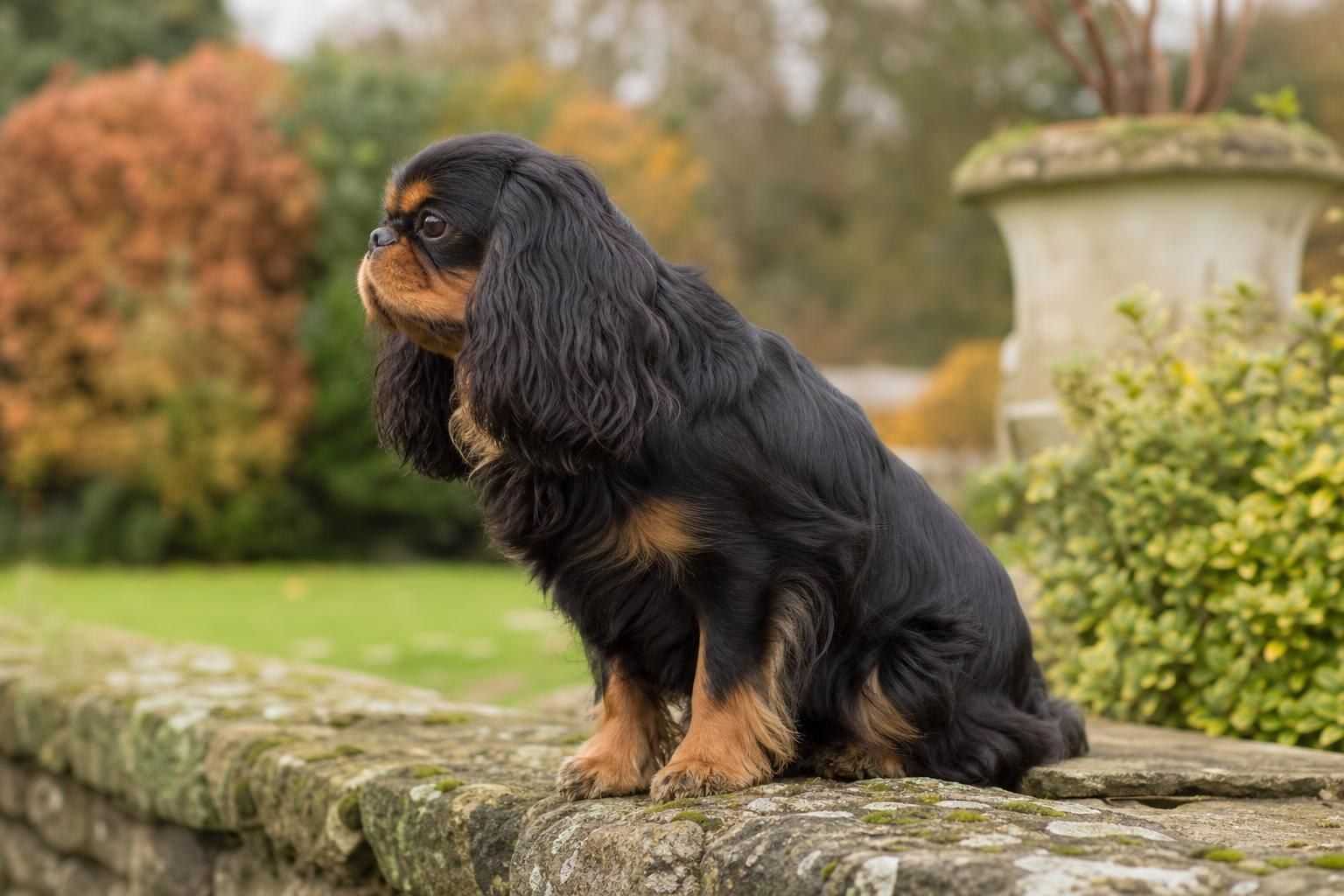
From the front, the Cavalier's face looks open and gently spaniel-like. The English Toy Spaniel's face looks rounder and more compact, almost like a small, solemn child's. Both have long, feathered ears, so the ears are no help.
The difference is not a matter of degree. It is the whole reason the Cavalier exists: Eldridge's prizes were offered specifically for the longer-nosed, flat-skulled type, and the Cavalier breed standard still describes a flat skull today.
If you are meeting a dog of either breed in person, a side view in good light settles the question in seconds.
Size and weight
The English Toy Spaniel is the smaller dog. The CKC standard, effective January 2011, gives a weight of 3.75–6.25 kg (8–14 lb). The CKC Cavalier standard, effective July 2019, gives 6.25–8.25 kg (14–18 lb) and a height of 30.5–33 cm (12–13 in). The UK Cavalier standard gives 5.4–8.2 kg (12–18 lb), and the AKC Cavalier standard 5.9–8.2 kg (13–18 lb) with a height of 30–33 cm (12–13 in).
Under the two CKC standards the ranges meet only at 6.25 kg, the top of the English Toy Spaniel range and the bottom of the Cavalier's. Against the lighter UK Cavalier figures they overlap a little, and individual dogs do not always sit inside their standard, so weight alone will not always tell two dogs apart. Taken as breeds, though, the English Toy Spaniel is the lighter, more compact dog.
The Cavalier breed profile covers what the Cavalier's size means for everyday life, from condos to winter walks.
Same colours, different names
Both breeds come in the same four colour patterns, but the English Toy Spaniel gives two of them their own names. In the CKC's terms, the black and tan variety is called King Charles and the tricolour variety is called Prince Charles. Blenheim and ruby keep the same names in both breeds.
That naming explains a lot of muddled conversations. A "King Charles" in English Toy Spaniel language is a black and tan dog, not the breed as a whole. A Cavalier of the same colour is simply a black and tan Cavalier.
For the Cavalier's four colours and what the standard says about each, see the colours guide.
Where their health overlaps
Shared ancestry brings some shared risks. The BVA/KC Chiari-like malformation and syringomyelia scheme in the UK describes the condition as confirmed as inherited in Cavaliers and Griffon Bruxellois, and lists the King Charles Spaniel among breeds where it is suspected to be inherited. The scheme uses MRI of the brain and upper neck and grades both conditions.
In Cavaliers the scale is well documented. A Dutch screening study of 1,020 Cavaliers over twelve years found Chiari-like malformation in every dog and syringomyelia in 39 %, increasing with age. Mitral valve disease is the Cavalier's other major issue, with murmurs in more than half of dogs by age 5 according to figures gathered by the owner-run resource Cavalier Health.
The English Toy Spaniel's short face adds the general concerns that come with any brachycephalic breed, which a vet can explain for an individual dog. Comparable Canadian data for the English Toy Spaniel was not found for this guide.
Whichever breed you choose, the rule is the same: ask what testing the parents had, and see the results. The health testing guide covers the Cavalier side in detail.
Reading a BVA/KC grade
A BVA/KC grade is written with the dog's age group, so a scan at one year and another after five tell you more than a single early result.
Telling them apart at a glance
For a quick check at a show, in a park or when reading an advertisement, these points do most of the work:
- Skull: flat on the Cavalier, domed on the English Toy Spaniel.
- Face: a real muzzle on the Cavalier, a short, flat face on its cousin.
- Weight: 6.25–8.25 kg for a Cavalier and 3.75–6.25 kg for an English Toy Spaniel, both under the CKC standards.
- Papers: the CKC registration names the breed exactly.
- Colour names: "Prince Charles" or "King Charles" as a colour points to an English Toy Spaniel.
None of these replaces papers and a conversation with the breeder, but together they rarely mislead.
Choosing between them in Canada
Both breeds are toy companions, and both are recognized by the CKC. The CKC Puppy List can be searched by breed and province, and the CKC advises contacting the national breed club for referrals. For Cavaliers that is the Cavalier King Charles Spaniel Club of Canada, which also keeps a breeder directory and a Code of Ethics.
The choice usually comes down to the look you prefer and the breeders you can reach. If you like the flatter face and a smaller dog, the English Toy Spaniel is the obvious candidate. If you want a slightly larger, longer-nosed dog with a sporting streak, it is the Cavalier.
Be wary of anything sold as a cross of the two, or as a "King Charles" without papers. The Cavalier mixes page explains what an unregistered cross does and does not give you, and the breeder guide lists the questions to ask.
Price ranges for English Toy Spaniels in Canada were not found in the sources behind this guide. For Cavaliers, the cost page has current figures, roughly $2,000–$4,000 from a reputable breeder.
Next stopCavalier mixesWhere the facts come from
- Canadian Kennel Club: English Toy Spaniel breed standard (PDF)
- Canadian Kennel Club: Cavalier King Charles Spaniel breed standard (PDF)
- Royal Kennel Club: Cavalier King Charles Spaniel breed standard
- American Kennel Club: Cavalier King Charles Spaniel history
- BVA: Chiari-like malformation and syringomyelia scheme
- Utrecht University: twelve years of CM/SM screening in Cavaliers
- Canadian Kennel Club: Puppy List